

Over the past few years, I’ve spoken with dozens of investors who’ve expressed regret about not seizing the opportunity the last time stocks were on sale. Now, we find ourselves in a similar situation: markets are once again offering discounts, but investors are weighed down by familiar uncertainties.
Many fear the stock price decline will continue. The future feels more uncertain than it has in a long time, and the news cycle is filled with endless scenarios of economic weakening. The media fuels fear — and fear sells.
This triggers a well-known cognitive bias: when negative information is fresh and readily available, we tend to overestimate the likelihood of worst-case scenarios. This is known as recency bias.
But what if we tried to fight back against that bias — and drew on the timeless wisdom of investing legends?
Act with calm determination when prices are low and uncertainty feels overwhelming.
Are Stock Market Discounts Already Deep Enough?
When a department store launches a clearance sale, demand usually rises. People feel they’re getting more value for their money. But when the stock market goes on sale, the reaction is often the opposite.
Low prices often come hand in hand with high uncertainty
Take 2022 as an example: many tech companies saw their stock prices plummet. Microsoft’s share price dropped by over 30%, and Alphabet (Google) fell more than 40% from its early-year highs.
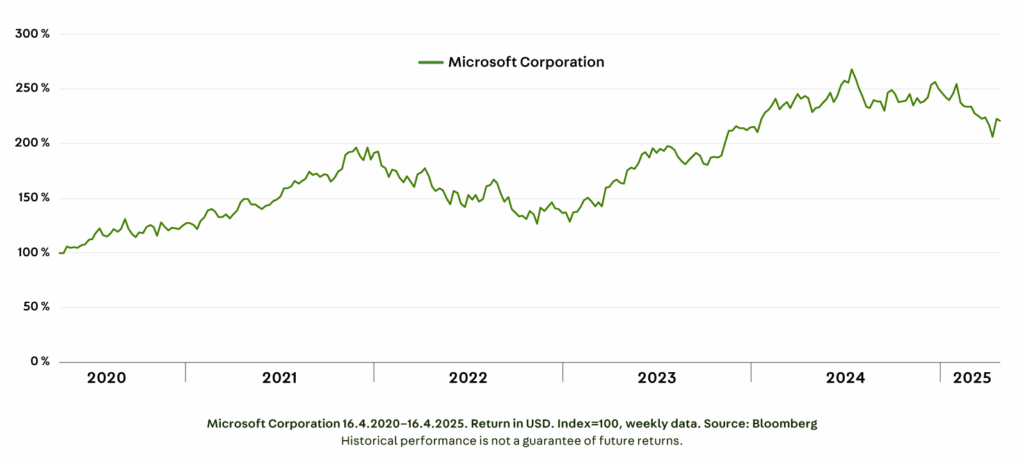
Was Microsoft’s business really in over 30% worse shape? Unlikely.
It’s worth asking the same question about many companies right now:
Is the company’s business truly 30% weaker if the market is pricing it 30% lower than it was two weeks ago?
The answer, of course, depends on the company. What matters most is understanding whether the company’s long-term earnings and business model remain intact — and how the market is currently valuing its future cash flows.
Stock market history is full of examples where a stock never returned to its previous highs. In such cases, the underlying business was either misjudged from the start — or had fundamentally and permanently deteriorated. In the same way, several high-quality stocks have already dropped beyond what their long-term cash flows suggest.
Two Scenarios — A View on the Current Situation
The current global environment, with new tariffs and trade tensions, is highly unpredictable. It’s difficult to form a clear view of the future, as both complex economic relationships and impulsive political decisions are in play.
Still, I’ll try to outline two opposing scenarios — neither of which is likely to unfold exactly as described, but they help illustrate the range of possible outcomes.
Temporary shock — A Positive Scenario
The U.S.-led trade war is just one tool in the administration’s broader playbook — a way for Trump to create chaos, renegotiate deals, and eventually lift most of the tariffs (while declaring victory). The core goal is to reduce the U.S. trade deficit, lower interest rates and borrowing costs, and cut public spending. After that, with the midterm elections approaching, it’s time to sweeten the message by promising corporate and consumer tax cuts.
In the best-case scenario, other countries follow suit by removing tariffs as well, helping to restore a cautious sense of confidence in the global economic system. The effects on global GDP would be temporary, and corporate profitability would remain intact. A stronger economic recovery could even follow.
In this scenario, the stock market could rally quickly.
Permanent deterioration — A Negative Scenario
In a more pessimistic scenario, the tariffs initially intended as a negotiation tactic evolve into a prolonged trade war that fractures global supply chains and erodes trust in the international trade system.
The consequences become embedded in the global economy, creating a negative spiral that weighs on corporate earnings for years to come. In response, both the U.S. and Europe slash interest rates and boost stimulus through debt-financed measures, ultimately fueling a return of inflation — this time, even higher.
Local businesses may cope, but only if consumer demand holds up. China could slip into a recession as exports weaken. Uncertainty lingers, affecting everyone, and markets swing wildly in response to news — but with a downward trend.
Economic distress leads to social distress, which may eventually spark unrest and conflict.
A conclusion and an Educated Guess
The key question is: how long could the worst-case scenario last — and how bad might it get?
I consider myself a realist, but I remain optimistic about human nature’s inherent greed.
I don’t believe the U.S. is willing to sacrifice decades of accumulated — and future — stock market returns and economic growth for the sake of a prolonged trade war. This is a country where making money and building wealth are core values — if not the most important ones.
That’s why I believe the tariffs and trade tensions will turn out to be a temporary chapter. Naturally, we may still see sharp market swings as negotiations play out and uncertainty persists. Confidence has been shaken — and it will take time to rebuild. However, I find it likely that greed will prevail before confidence returns.
Santeri Korpinen
CEO

