

Identifying high-quality businesses is a necessary condition for long-term investing, but it is not a sufficient one. Buy and forget is not an automatic route to good returns. Keeping the portfolio’s valuation discipline intact is as important as buying quality companies.
By valuation discipline we mean that the portfolio’s holdings are reasonably priced relative to the long-term earnings we expect the businesses to generate.
Valuation discipline is precisely where many funds that emphasise long-term ownership quietly lose their edge.
High confidence in a business gradually becomes a reason to treat its share price as secondary, and a long ownership history makes trimming psychologically difficult.
In Sifter Fund’s strategy, valuation sits within the same process as the assessment of business quality.
The fifth-year earnings yield anchors the process
Unlike many investors, we do not set target prices for our holdings. Target prices can create an illusion of precision and trigger decisions mechanically at the wrong moments.
Instead, we calculate a fifth-year earnings yield for every holding. In essence, we forecast the company’s adjusted net earnings five years forward and divide that figure by its current market capitalisation.
The fifth-year earnings yield tells us what an investor pays today for the earnings power the business is expected to generate five years from now.
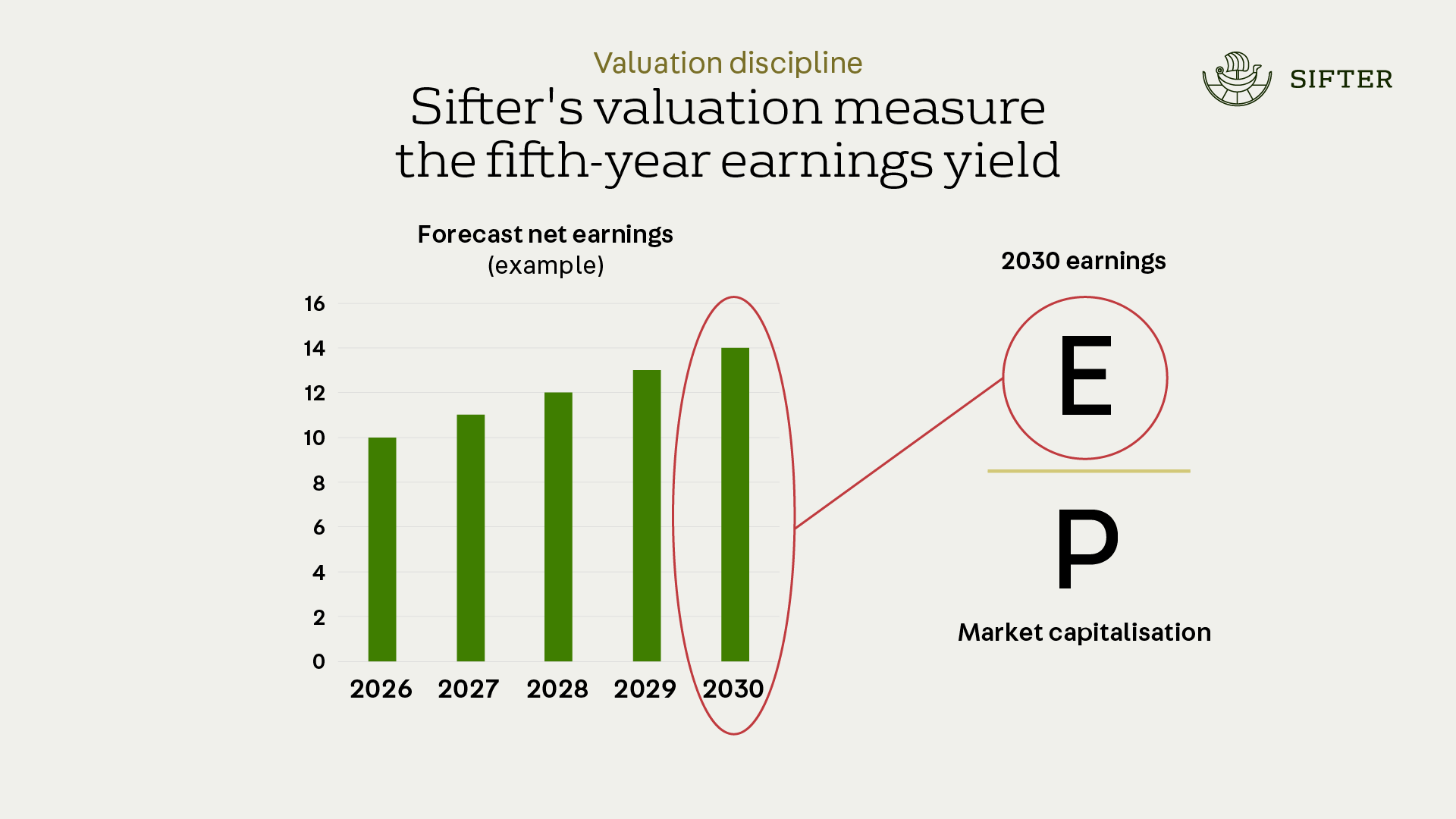
The earnings yield is deliberately relative. We do not compare it to the risk-free rate or to the market’s general valuation level. We compare it to the other quality companies in our portfolio.
Our aim is to keep the valuation level of the portfolio as a whole within a sensible range.
All of the roughly 30 holdings in the portfolio are held in a continuous ranking ordered by this figure. Capital is directed towards the top of the ranking, where the earnings yield is highest relative to risk. Positions at the bottom are trimmed.
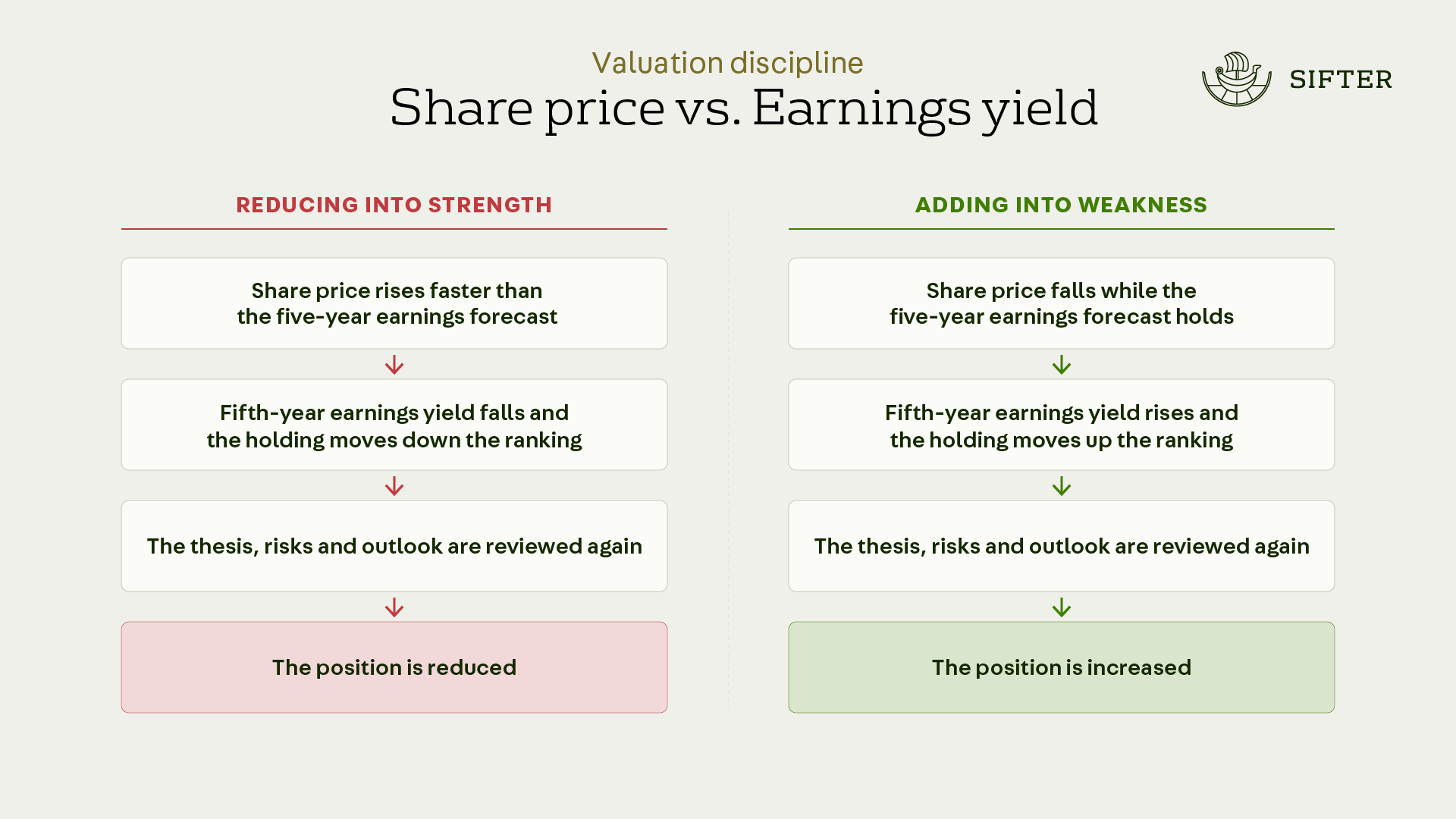
The mechanism is simple but disciplined: when a share price rises materially faster than the company’s long-term earnings forecast, the earnings yield falls and the company drops in the portfolio ranking. We then trim its weight in the portfolio.
When a share price falls and the earnings yield improves, the company rises in the ranking. The investment thesis is analysed again, and if the case holds, the weight is increased.
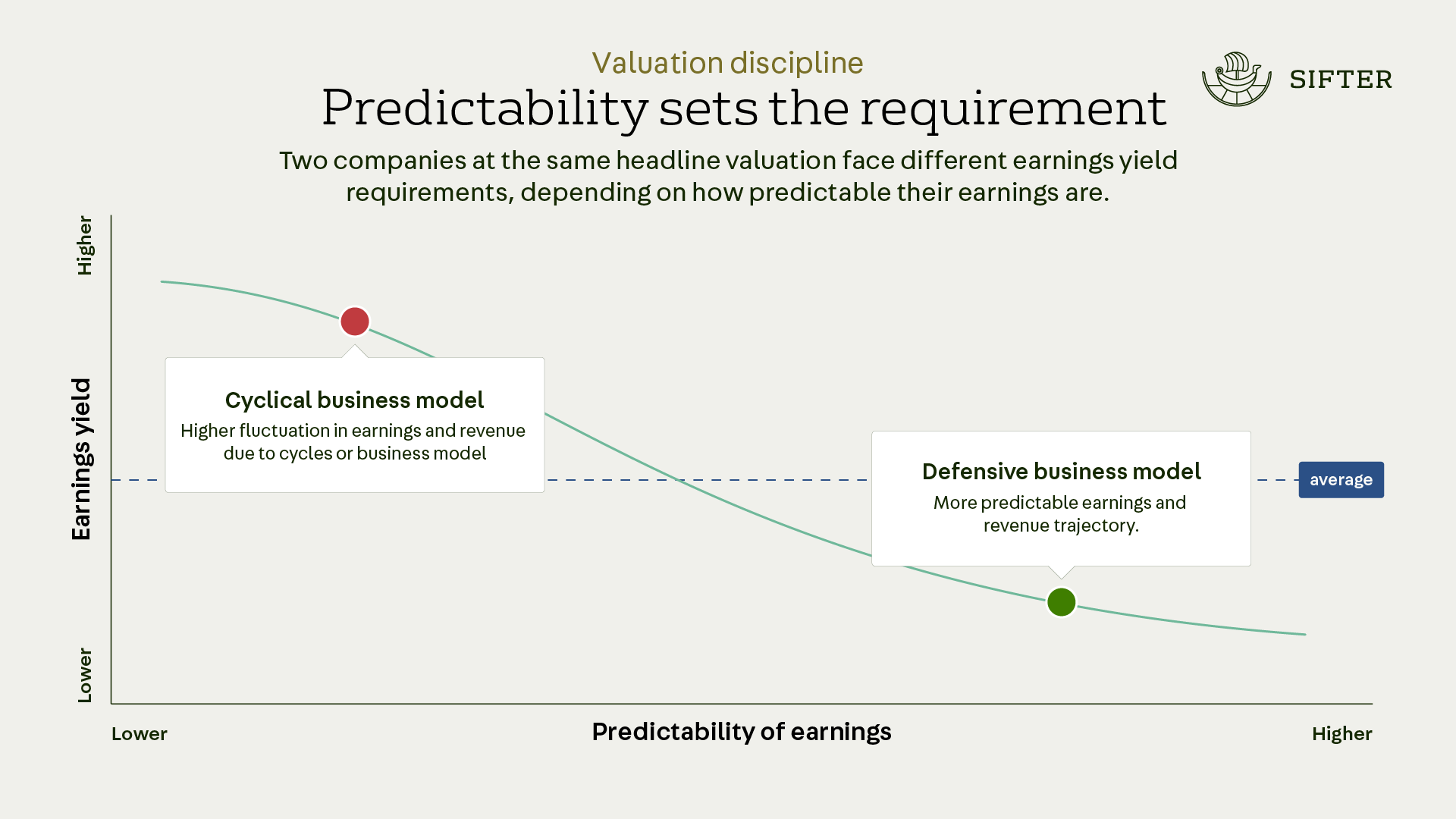
Predictability of the business model sets the requirement
The process does not treat all companies identically, and it should not. A highly predictable business such as Costco, where the majority of revenue is tied to membership fees and long-standing customer relationships, can be accepted at a lower earnings yield. The dispersion of forecast cash flows is narrow, and the results can be modelled with greater confidence.
Cyclical companies, whose earnings can move sharply with the industrial cycle, are held to a higher requirement. The uncertainty premium is built into the threshold.
Quarterly rebalancing of the portfolio
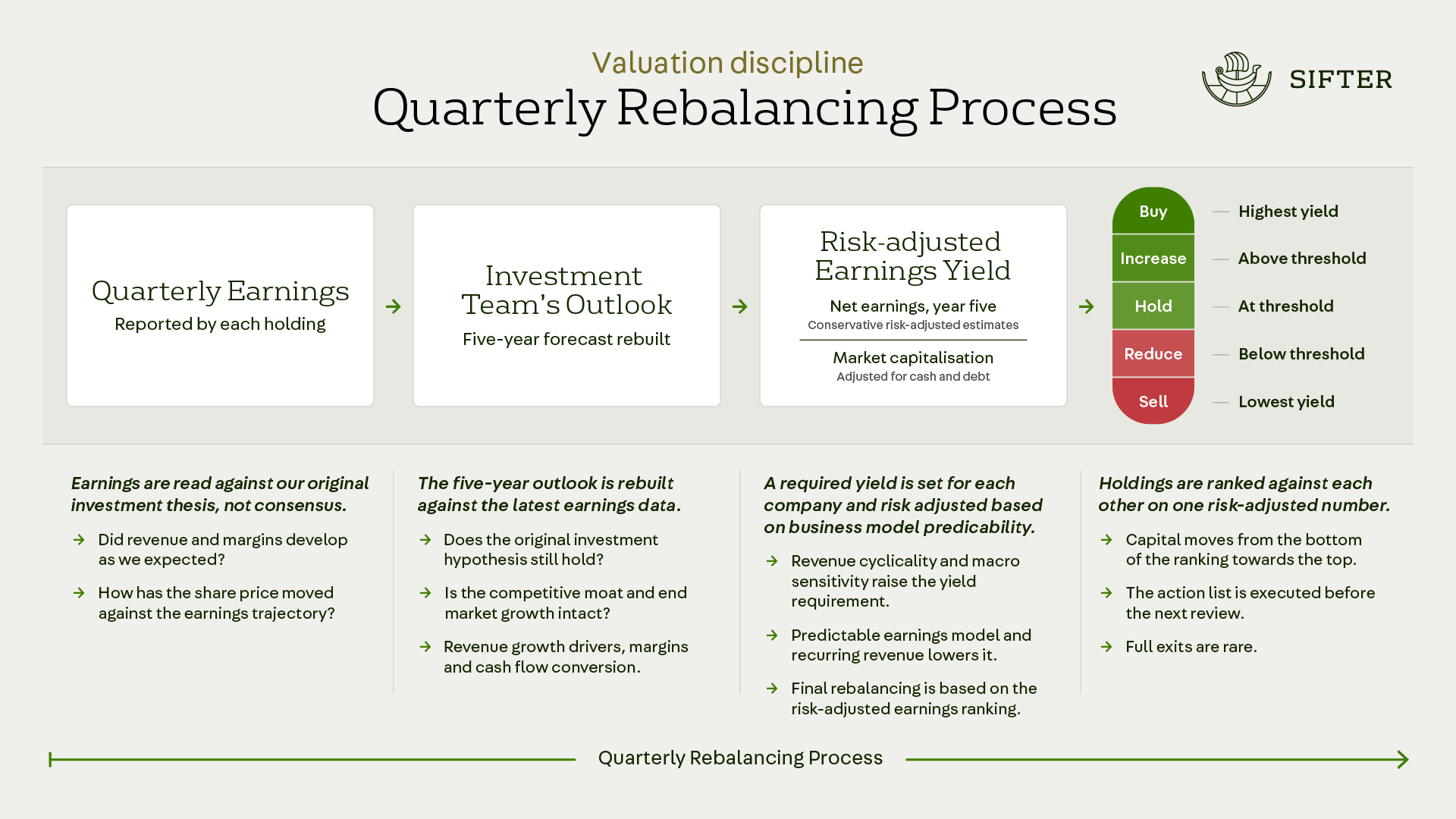
Four times a year we review the entire portfolio according to a systematic process. The review is not a monitoring exercise. It is a decision-making process, and its output is a concrete list of positions to add to and positions to trim.
Quarterly earnings
The process begins when the portfolio companies report their quarterly earnings.
We read the results against our original investment case, not against consensus.
- Did revenue and margins develop as we expected?
- Are the competitive moat and end market growth intact?
- How has the share price moved relative to the earnings trajectory?
The investment team’s outlook
Based on the results, the five-year earnings forecast for every holding is rebuilt from the ground up.
We assess four things:
- Revenue and earnings growth drivers
- Company-specific metrics
- Capital intensity and free cash flow conversion
- The competitive landscape and risks
We forecast consistently somewhat below consensus: if we are wrong, we prefer to be wrong in the direction of caution.
Risk-adjusted earnings yield
Alongside the forecast, the risk profile of every holding is updated.
- Revenue cyclicality
- Durability of the competitive position
- Quality of management
- Regulatory risk
- Balance sheet strength under a stress scenario
The risk assessment determines how high an earnings yield we require from the company. Revenue cyclicality and macro sensitivity raise the requirement. Predictable earnings and recurring revenue lower it.
The earnings yield itself is a division: net earnings in year five divided by market capitalisation, adjusted for net cash and net debt. The adjustment is made so that differences in capital structure do not distort the comparison between companies.
Ranking and rebalancing
Once the risk-adjusted earnings yield has been calculated for every holding, all positions are placed in the ranking.
The ranking translates directly into instruction:
- Capital moves from the bottom of the ranking towards the top.
- The action list is executed during the current quarter.
Full exits are rare. They require either a fundamental breakdown of the investment case or an earnings yield that has fallen decisively below an acceptable level.
The portfolio correlation assessment runs alongside
Alongside the assessment of individual companies, we look at the portfolio as a whole.
- Exposure to a shared end market
- The aggregate weight of cyclical businesses
- Sector and geographic diversification
In June 2026 it was this assessment that confirmed the decision to trim our semiconductor exposure. The combined weight of six semiconductor holdings had grown to approximately 25% as share prices rose, and their earnings forecasts were highly correlated with a single driver, namely demand for artificial intelligence infrastructure.
This is not market timing. It is the consistent risk management of the relationship between price and value, applied across all market environments.
Case Microsoft: building a position as the share price fell
Valuation discipline and the weighting mechanism also create opportunities. Microsoft’s share price fell by close to 23% over the first half of 2026. The market was pricing rising uncertainty about the timetable on which artificial intelligence investment would generate returns, together with the disruption risk that artificial intelligence itself creates.
During the spring we carried out a full reassessment of Microsoft’s business.
Our research indicated that the outlook for Microsoft’s business had changed considerably less than the share price implied.
A commercial customer base of hundreds of millions of users, multi-year enterprise agreements and Azure’s structural growth position together form a cash flow stream whose predictability remained high.
As the share price fell, Microsoft’s fifth-year earnings yield rose to the top of our ranking, an unusual position for one of the highest-quality businesses in the world.
We added to the position in February, in April, and again in June, when the shares were trading close to their lows for the half-year.
At the end of July, Microsoft reported its fourth-quarter results: revenue grew 18% year on year. Azure passed USD 100 billion in annual revenue for the first time, and Azure growth accelerated to 43%. Over July the shares rose 24.6%, including 15.5% on results day, 30 July.
Our valuation process had identified a mispricing. Following that process with discipline allowed us to benefit from the subsequent normalisation. We continue to follow Microsoft’s business closely.
23 years of continuous rebalancing: what it has produced
In June 2026 Sifter Fund Global reached its 23rd anniversary. Over the full track record the cumulative return has been 858% after all fees, approximately 140 percentage points more than the global equity index and approximately 400 percentage points more than the peer group average.
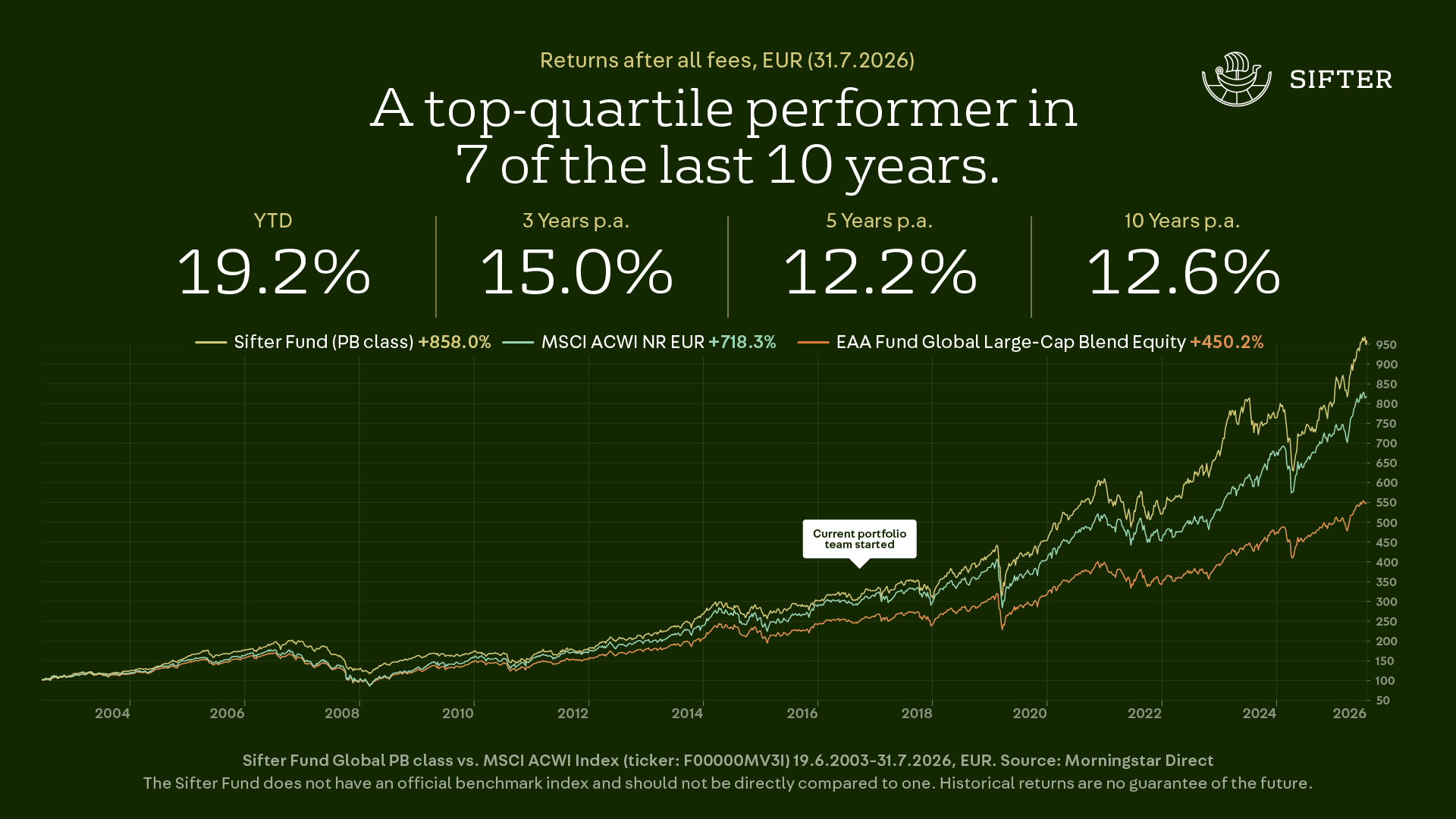
This return has not come from successfully timing a small number of large positions. It has been produced by moving capital systematically towards the holdings offering the most attractive earnings yield.
Any single rebalancing round is marginal in isolation. Cumulatively, the continuous reallocation of capital accounts for a meaningful part of the long-term excess return.
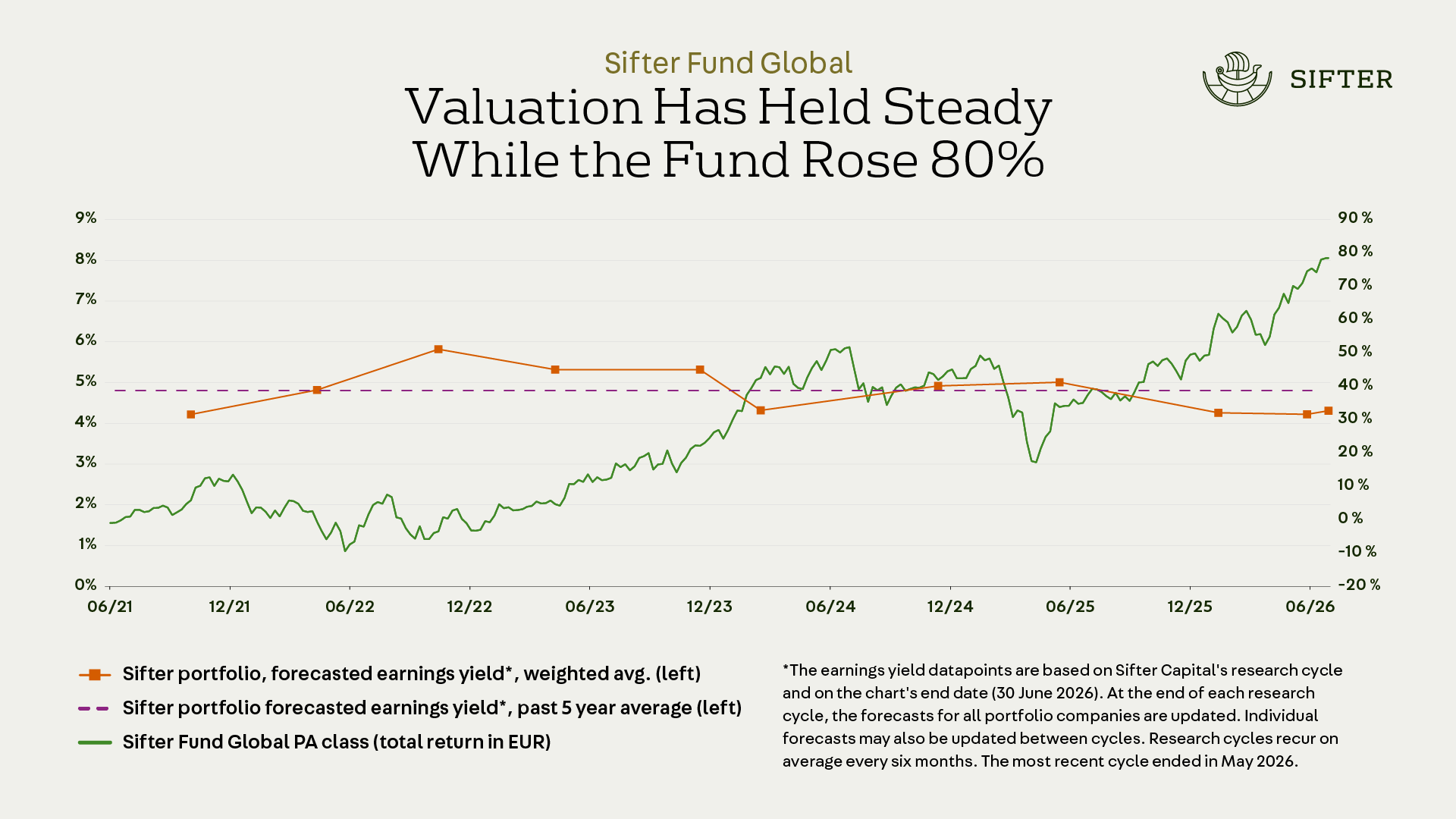
Buy the quality businesses at a reasonable price. Own them for a long time. Trim when the valuation no longer reflects the risk-adjusted return expectation. Put the released capital where it does the most work.
None of this requires the ability to forecast the market cycle. It requires a process that keeps valuation discipline in force during the periods when everything appears to be going exceptionally well.
Discipline is rarely visible in a single quarter. It is visible in a 23-year track record.
Santeri Korpinen
CEO, Sifter Capital

