

July was anything but calm in the stock markets. The month saw several factors negatively impacting stock prices. The common denominator for these changes was uncertainty and overly optimistic market expectations regarding companies’ earnings.
The most likely reasons for the decline in stock prices in July:
1. Uncertainty brought by the U.S. presidential elections
2. Differences between companies’ Q2 earnings and market expectations
3. Discrepancies between expectations and outcomes in artificial intelligence (AI)
While interest rate cuts have been eagerly anticipated, a new concern has emerged regarding the US employment situation and a potential recession. This mix of conflicting messages and situations has undermined investor confidence in stocks, reflected in their declining prices.
Uncertainty brought by the U.S. presidential elections
During the U.S. presidential debates, presidential candidates talked enthusiastically about technology export restrictions to China, which particularly weakened the prospects of semiconductor companies.
Although similar speeches and actions have occurred before, the stock markets interpreted these statements negatively this time. As a result, potential risks were mitigated by selling shares of technology companies, especially semiconductor companies.
Differences between companies’ Q2 earnings and market expectations
In mid-July, several companies released their Q2 earnings and outlooks. For example, Alphabet’s earnings were good, but the markets expected super surprises that Alphabet could not provide. This led to a decline in the company’s stock.
The same happened with Microsoft, whose earnings were good: the company’s revenue grew by 15% from a year ago and earnings per share increased by 10%. However, the growth driver of the company, cloud services (Azure), fell one percentage point short of market expectations (29% vs. 30%), leading to the interpretation of a slowdown in growth.
The markets seem to expect super surprises, and growing earnings may be interpreted as disappointments.
However, one super surprise was found in the Sifter portfolio: Norwegian TOMRA Systems, whose revenue and earnings were significantly higher than market expectations and the company’s own goals. TOMRA Systems’ stock acted as a bright spot in an otherwise red July.
Discrepancies between expectations and outcomes in artificial intelligence (AI)
During the spring, artificial intelligence and its impact on companies’ earnings have been a hot topic of discussion and a theme that raises stock prices.
Many large companies, such as Alphabet, Microsoft, and Amazon, have invested tens of billions in developing artificial intelligence, and investors expect these investments to yield significant results. When Alphabet, for example, did not directly announce the returns on its AI investments, the markets were disappointed and interpreted the situation as AI may not necessarily meet commercial expectations.
On the other hand, large companies like Meta (which Sifter does not own) have announced they will invest $40 billion this year, with most of it going into developing artificial intelligence. This means that chips, semiconductors, and data centers will be needed even more in the future.
While it is impossible to accurately assess how quickly and significantly AI investments will affect productivity and company earnings, massive investments have already been seen in sales growth of semiconductor companies and equipment manufacturers. Whether AI is a boom or not, it creates real demand and money for “picks and shovels” manufacturers.
History of market corrections and bear markets
Significant stock price declines have been experienced during the history of the Sifter Fund. Over 21 years, the fund has had negative returns in four years and positive returns in 17 years.
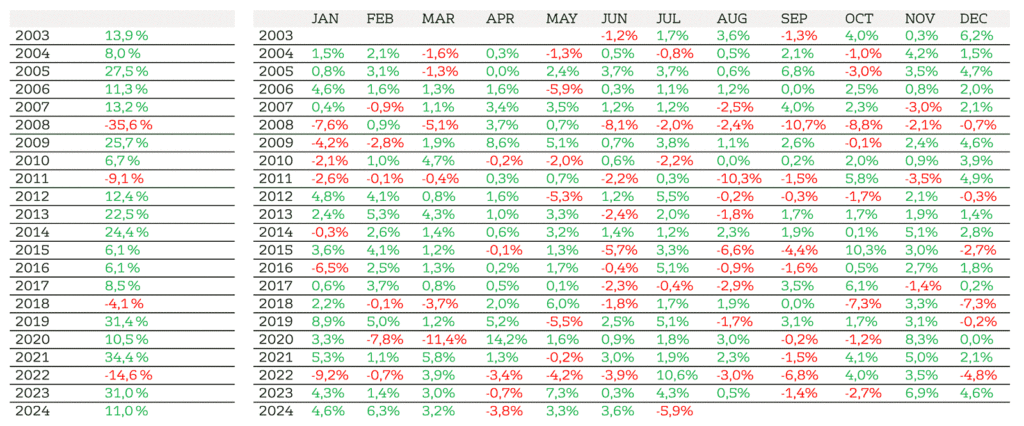
Remember that historical performance is not indicative of future performance.
Market corrections, defined as at least a 10% decline from recent highs, are relatively common. From 1952 to 2022, such corrections have occurred on average once a year (FactSet). Corrections can be caused by many factors, such as economic changes, geopolitical events, or fluctuations in investor sentiment, and they are a normal part of the market cycle.
Bear markets, defined as at least a 20% decline, are somewhat rarer. From 1952 to 2022, bear markets have occurred on average once every six years (FactSet). Historically, bear markets have lasted an average of 370 days, and markets have always recovered over the long term.
It is important to note that when we talk about market recovery, we generally refer to indices such as the S&P 500 or globally diversified stock indices (MSCI World). In some markets, recovery to all-time highs has taken decades, such as the NIKKEI in Japan or OMXH25 in Finland. For example, after the peak of the 2000 technology boom, the OMXH25 (Finland) index reached the same levels again only in 2015, meaning that recovery took about 15 years.
How does Sifter operate in stock market declines?
Sifter is always 100% invested in high-quality companies. One of our investment principles is that we do not sell our holdings even if stock prices decline significantly. We believe that the value of carefully researched and selected companies’ business does not deteriorate, even if the stock market wants to pay 30% less for the company tomorrow.
If a company’s earnings model, competitive advantages, and pricing power are sound, we believe such a company is worth owning over the long term.
Sooner or later, the stock market will realize this and may be willing to pay significantly more for it.
If, on the other hand, a company’s ability to generate cash deteriorates permanently, we quickly sell the company and replace it with a better one.
However, we do not want to own overpriced companies in our portfolio. Sometimes, in its greed, the stock market prices a company’s stock too high. In such cases, we make our own assessments and reduce the weight of that stock in our portfolio. For example, during this spring, we reduced the weight of the Japanese semiconductor company Disco Corporation in our portfolio, which was a beneficial decision for the fund’s investors in the short term.
Market declines also create opportunities
The stock market is systematic in its manic-depressive nature. Sometimes the market’s faith in stocks is way too high, and greed obscures rational thinking. On the other hand, depressiveness, worries, and uncertainties unjustifiably lower prices. It is precisely in these situations that long-term investors have opportunities to act.
If you want to buy more stocks in a declining market, you must be sure of two things.
1. You must know the company’s strengths so well that you are willing to buy more of it for long-term portfolio. Bad business doesn’t easily turn into good, even if the company’s stock is cheap. Therefore, the investor must ensure that the decline in the share price is not related to the company’s competitive decline or a permanent decline in the market demand.
2. Investors need mental strength to stay invested in quality companies, even if the stock market may be bearish for a long time. Sooner or later, the market turns optimistic, and the patience of long-term investors is rewarded.
Historically, the best days and months for market gains have followed the largest declines. However, predicting market ups and downs is impossible, which is why the Sifter Fund remains 100% invested in high-quality companies in all market conditions.
Santeri Korpinen
CEO

