
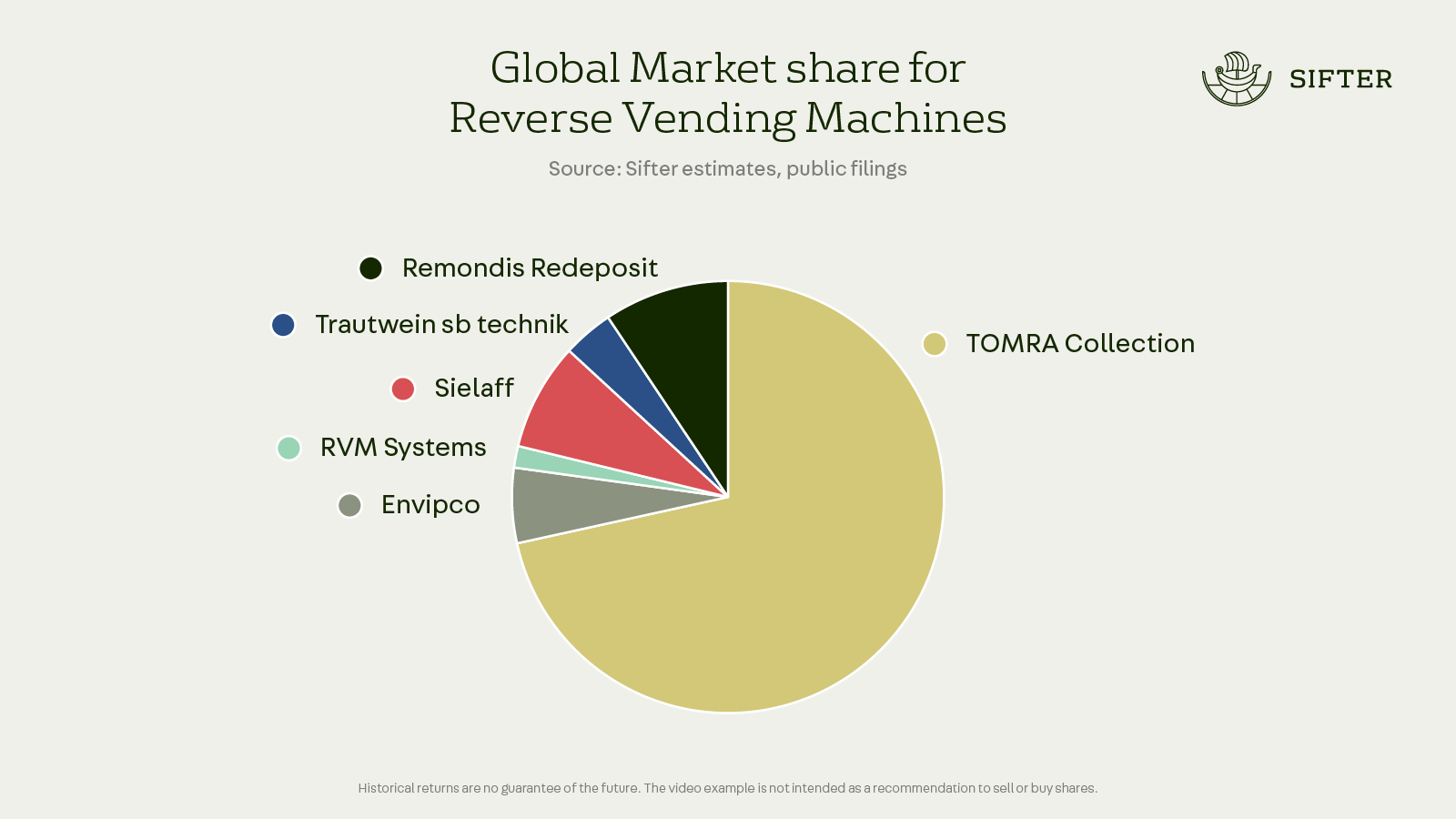
TOMRA Systems celebrated its 50th birthday during the peak of the COVID-19 pandemic and the first days of 2022 also marked the peak for the share price for the company. Coincidentally, the company has just appointed a new CEO a few months prior as the previous CEO quietly departed for personal reasons. What followed next was two tough years of headwinds.
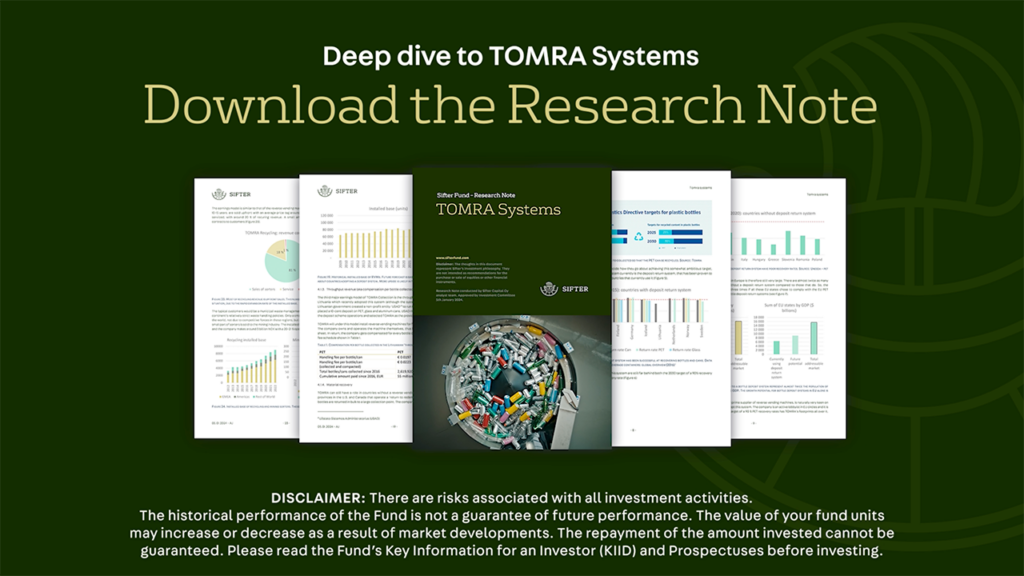
Download TOMRA Systems Research Note (PDF)
The sudden rise of interest rates cut down on customer’s willingness to invest and the company found itself trapped by previous agreements to sell machinery at fixed prices, whose profit margin was quickly eaten up by rising cost inflation.
Consequently, the stock price declined over the next two years as these headwinds materialized as negative earnings surprises.
The company appeared on the Sifter radar in early 2023 as an interesting investment candidate, but the price was deemed too high.
One-year later the price was down another -40 %, while the business fundamentals and long-term outlook remained intact. It was at this point, in the very first days of 2024 that Sifter recognized that this overlooked quality company could be acquired at a very attractive price.
What is TOMRA Systems
The company is in many ways a green economy ESG darling. The company makes products that facilitate the collection and recycling of plastic waste. In practise the company operates in three segments:
- TOMRA Collection, which is mainly the manufacture and sale of reverse vending machines.
- TOMRA Recycling, which is the manufacture and sale of sorting equipment for the waste management industry.
- TOMRA Food, which manufactures and sells sorting equipment for raw and processed food manufacturers.


TOMRA Collection is the most important segment
Reverse vending machines are used to automate the collection of plastic bottles, glass bottles and aluminium cans from consumers. These are necessary tools in countries that have implemented a deposit return system (DRS), in which consumers gets compensated for returning recyclable bottles and cans.
This concept was pioneered by the Swedes and Norwegians who collected re-fillable glass bottles already in 1885 and 1902.

The Norwegians were the first to automate the collection process by the introduction of TOMRA’s machines in the 1970s.
In 1984 the Swedes refined their recycling system by introducing a deposit on recyclable plastic bottles and cans thus creating the modern deposit return system we know today.

Growth is driven by the European Union that requires it’s countries to ensure the collection of at least 90 % of single-use plastic bottles 1.
To achieve this 90% goal they must implement a deposit return system, as this is the only method proven to achieve this recycling target.

The business case for TOMRA is not just driven by EU bureaucrats as there is additional interest in deposit return systems and TOMRA machinery outside of EU regulations.
Uruguay and Singapore are about to introduce this system in coming years, and even China is performing initial pilot trials in Hong Kong and Shanghai.
The future for TOMRA’s collection segment is therefore great. Regulatory pressure force EU countries to buy reverse vending machines and interest in a green economy cause voluntary adoption of deposit return systems world-wide.
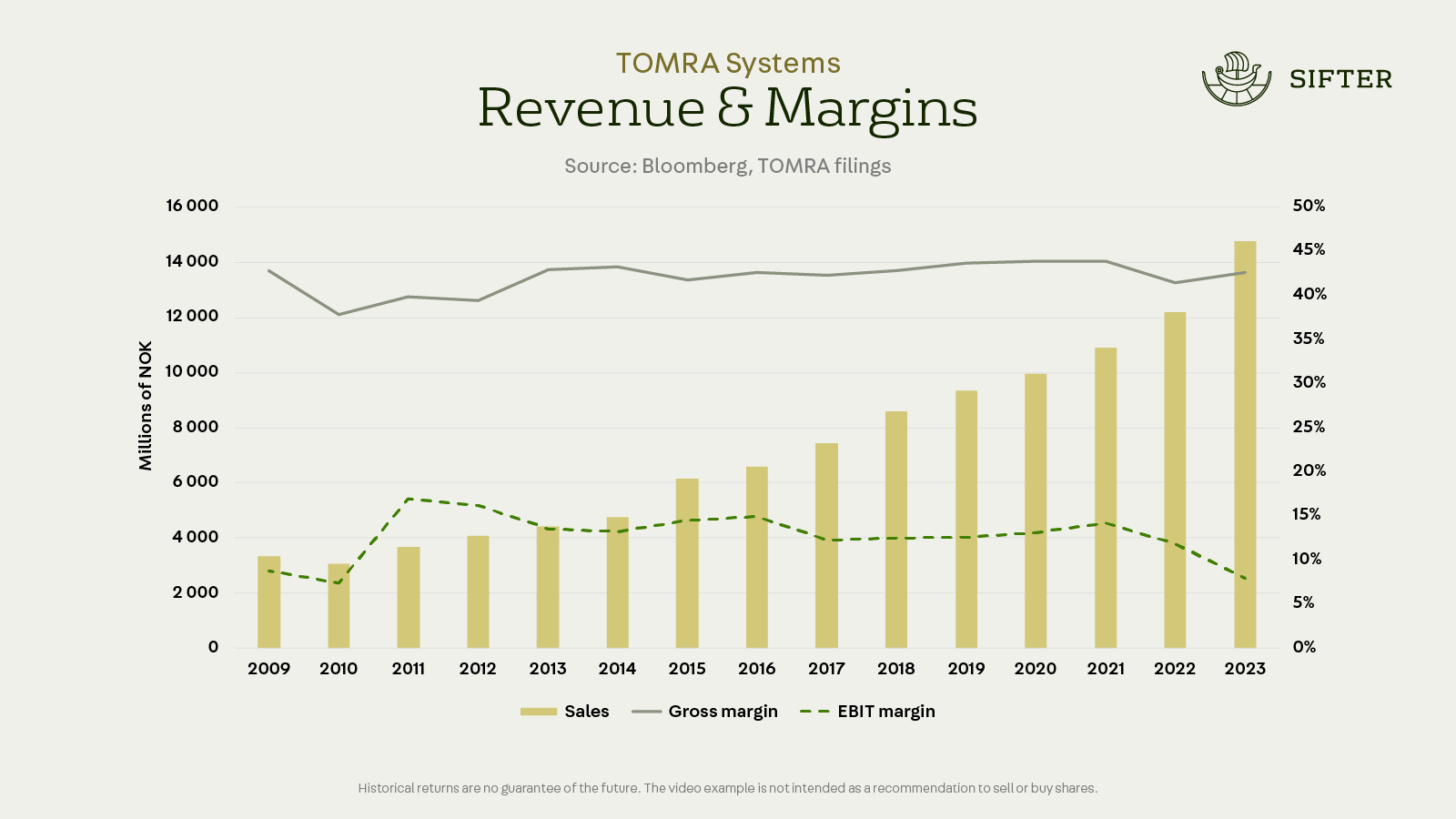
TOMRA has a 70 % market share in reverse vending machines
Tomra can produce more machines, that are more reliable and at a cheaper price than its competitors and this will allow the company to defend its 70 % market share in this fast-growing industry.
TOMRA Recycling segment
The trends in the Recycling segment mirror the trends seen in Collection. Sorting equipment is sold by TOMRA to municipal and industrial companies that invest in waste recycling.
This is a sector that has previously been neglected in many parts of the world, as is it cheaper and easier to dump waste in landfills rather than to go through the process of recycling 2.
Thankfully this is about to change. There are both regulatory pressures supporting investments in recycling initiatives.
For example, the European Union is again leading the pack by raising the recycling rate of municipal waste from the current 50 % to 65 % by 2035.
There are similar non-regulatory initiatives outside of the European Union as the rest of the world is opening its eyes to the benefits of a green and sustainable future.

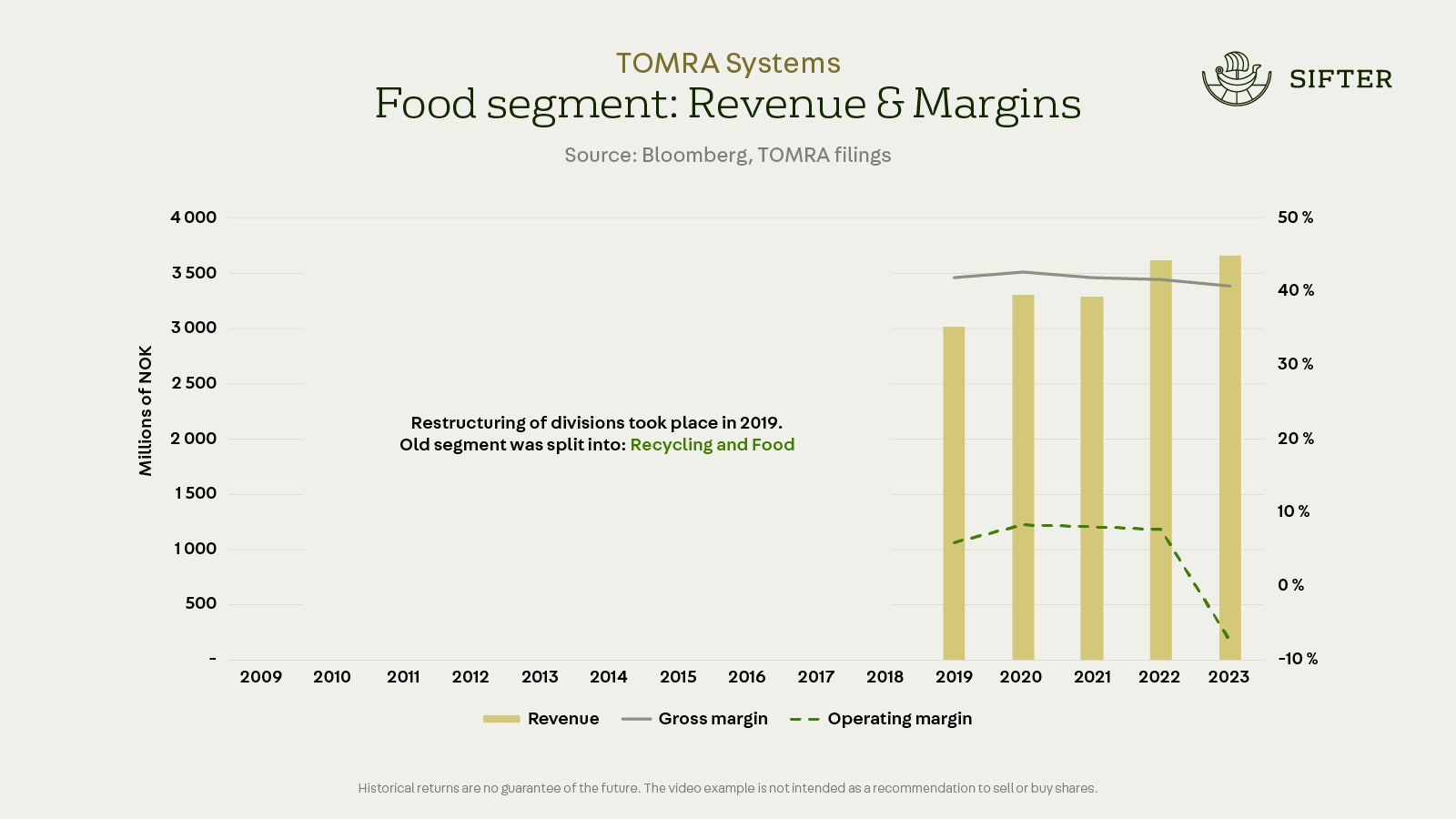
The food segment is the black mark on TOMRA’s otherwise spotless business
It is the result of many previous acquisitions in which TOMRA attempted to consolidate a fragmented market and thereby achieve scale advantages and reduce competition. So far this has not worked, as the segment has struggled to achieve good returns on invested capital.
What is the earnings model?
The three operating segments share very similar business model characteristics. The company sells equipment upfront (~20,000 € for a reverse vending machine; ~100,000 € or more for sorting machines). These machines last for around ten to twenty years before they are completely depreciated in a technical sense.
TOMRA’s sales grow rapidly when a new country adopts a deposition return system, leading to a lot of equipment being sold in a short period of time.
The company also benefits from the growth of its installed base of equipment, as maintenance and servicing account for about 20% of the company’s revenue.
Technically, TOMRA’s machines last about ten to twenty years before they are replaced with new equipment.
Hidden upside potential?
TOMRA has an additional, hidden, operating segment in addition to these three. This is the TOMRA Horizon venture, which is the ‘venture-capital’ arm of the business that aims to provide new revenue streams in the future and can be compared to the ‘Moonshot projects’ that Google pioneered.
The current new ventures are plastic feedstock sorting plants in Germany and Norway, which aim to sort household plastic waste into multiple grades for further recycling.

Image: TOMRA Systems
Will these ‘moonshot’ projects actually generate significant revenue in the future? We don’t know, but these projects are at least within the core competency of TOMRA (sorting equipment and reverse vending machines) and support the general trend for more sustainable and greener global economy. It is therefore justified for TOMRA to test the waters and invest a fraction of the profits in these projects.
Conclusion – Market leader in a growing niche market
We believe that the inflation related headwinds are over and that TOMRA will once again grow both its top- and bottom line in the Collection and Sorting segments.

Tighter EU regulations is for once a tailwind for this particular company and the general trend to reduce our human footprint on the ecosystem is supporting future investments.
The Food segment remains a question mark that we will eagerly follow and monitor, but luckily this is only a minor part of the future earnings potential – and this is what matters most to us.
Alexander Järf
Portfolio Manager
Download TOMRA Systems Research Note (PDF)
At Sifter Fund, we focus on conducting high-quality research and analysis before making any investment decisions. We value transparency and seek to highlight the diligence of our investment process by sharing our comprehensive research notes with our investors.
Do you want to know what a quality company analysis looks like? Download the Research Note