
Q3 2026 was a more measured quarter for markets and for the Fund. The Sifter Fund returned +2.0% in the quarter, with the year-to-date figure standing at +21.2% as of 30 September 2026 (PB class). After an exceptional first half, consolidation at this level is exactly what disciplined long-term ownership looks like.
During the first half of the year (January-June 2026), semiconductor companies delivered even triple-digit returns, while the shares of software companies came under pressure from the perceived threat of AI. In the third quarter, the roles reversed.
The share prices of semiconductor companies turned sharply lower in July. The reversal did not, however, come as a surprise, as the companies’ valuation levels had risen high.
Over the short term, the rises and falls in share prices reflect market sentiment more than the companies’ actual earnings development.
Please note that the Fund’s past performance is not a guarantee of future results.
Fund Performance
Over its more than 23-year history, the Sifter Fund has outperformed both the global equity index and the comparison category set for us by Morningstar. The return gap relative to the indices has widened over the past ten years.
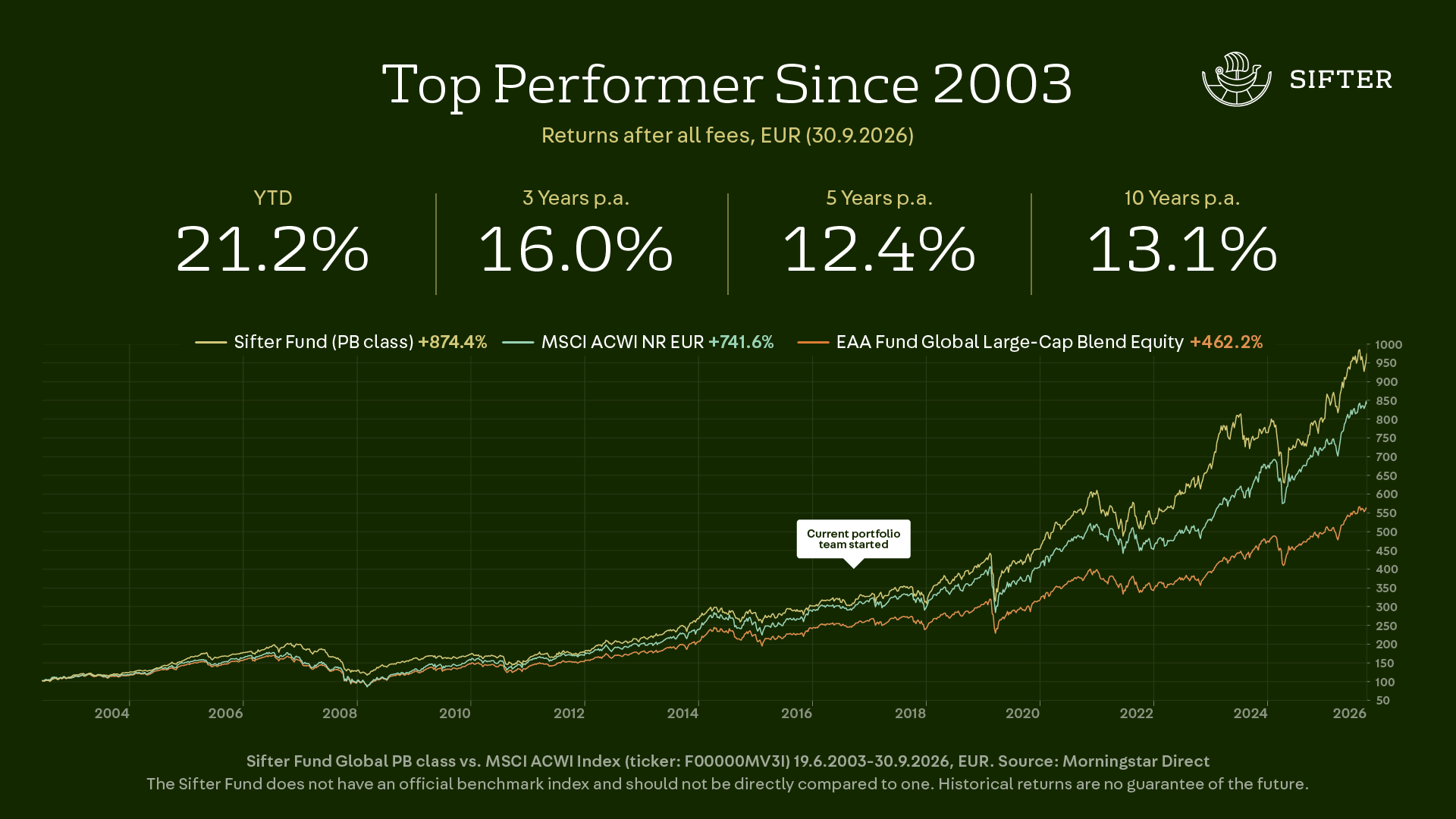
Although Sifter does not beat the index every year, it is precisely the steady long-term return that we value most as investors. It is built over the years, not in a single quarter.
Top Performers
The strongest share-price returns of the third quarter came from three very different companies, each for its own reasons.
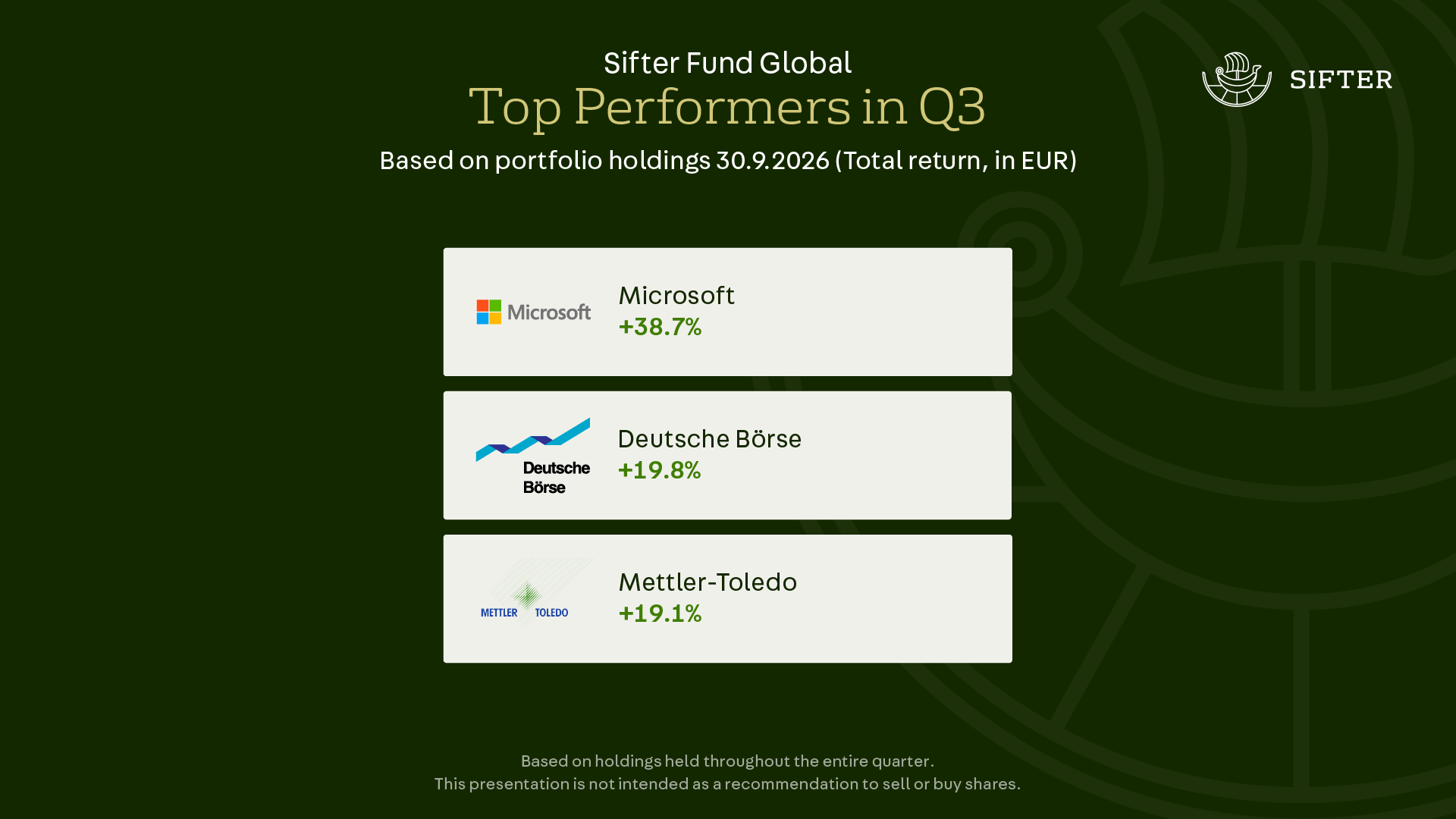
Microsoft’s share rose nearly 40% during the quarter, as the market’s concern over the disruptive threat of AI eased and the company’s cloud business grew more strongly than expected. The same tailwind also lifted another software company, the US-based ADP. We had already increased its weight in the portfolio in June, when the share price had fallen considerably.
We increased Microsoft’s weight in the portfolio during the first and second quarters of the year, when in our view the company’s share price was underpriced relative to its long-term return potential.
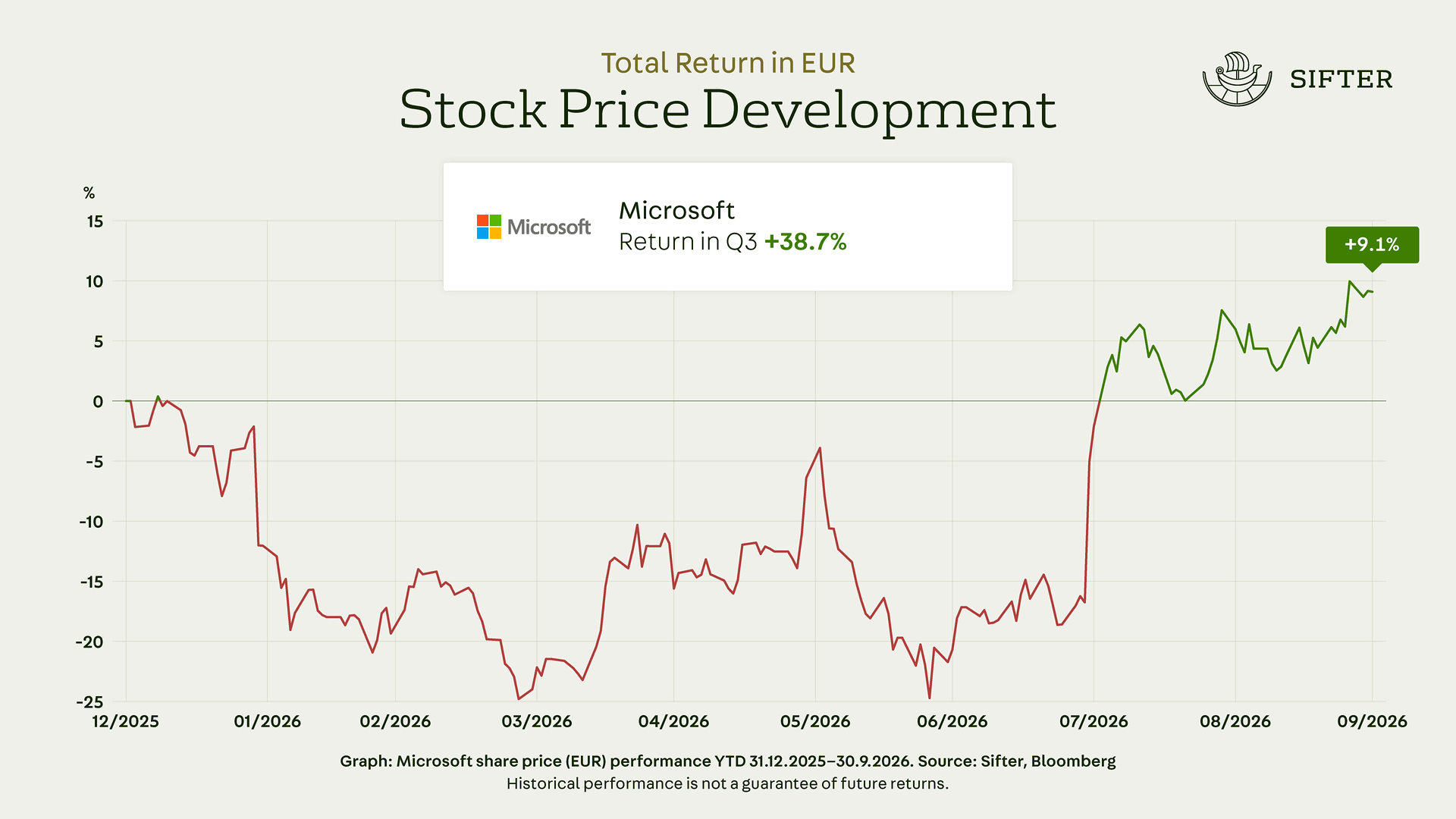
Behind Deutsche Börse’s share-price rise was the lively trading in equity markets during July and August. As a defensive company, it benefits precisely from market volatility and increased trading activity. In the case of Mettler-Toledo, replacement investment demand in the pharmaceutical industry finally appeared to be returning after several slower years.
Bottom Performers
The bottom performers of the third quarter were all semiconductor equipment manufacturers.
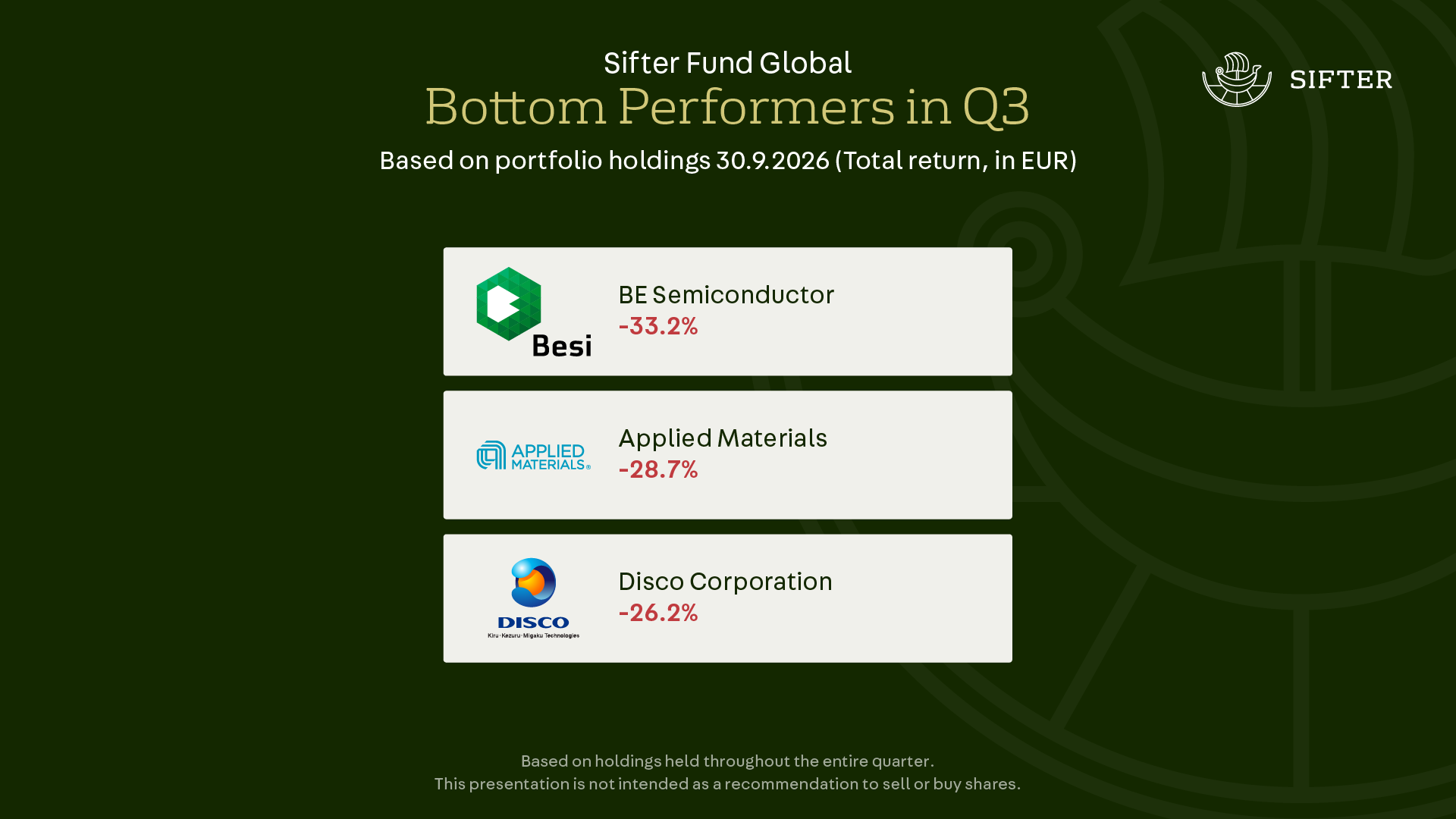
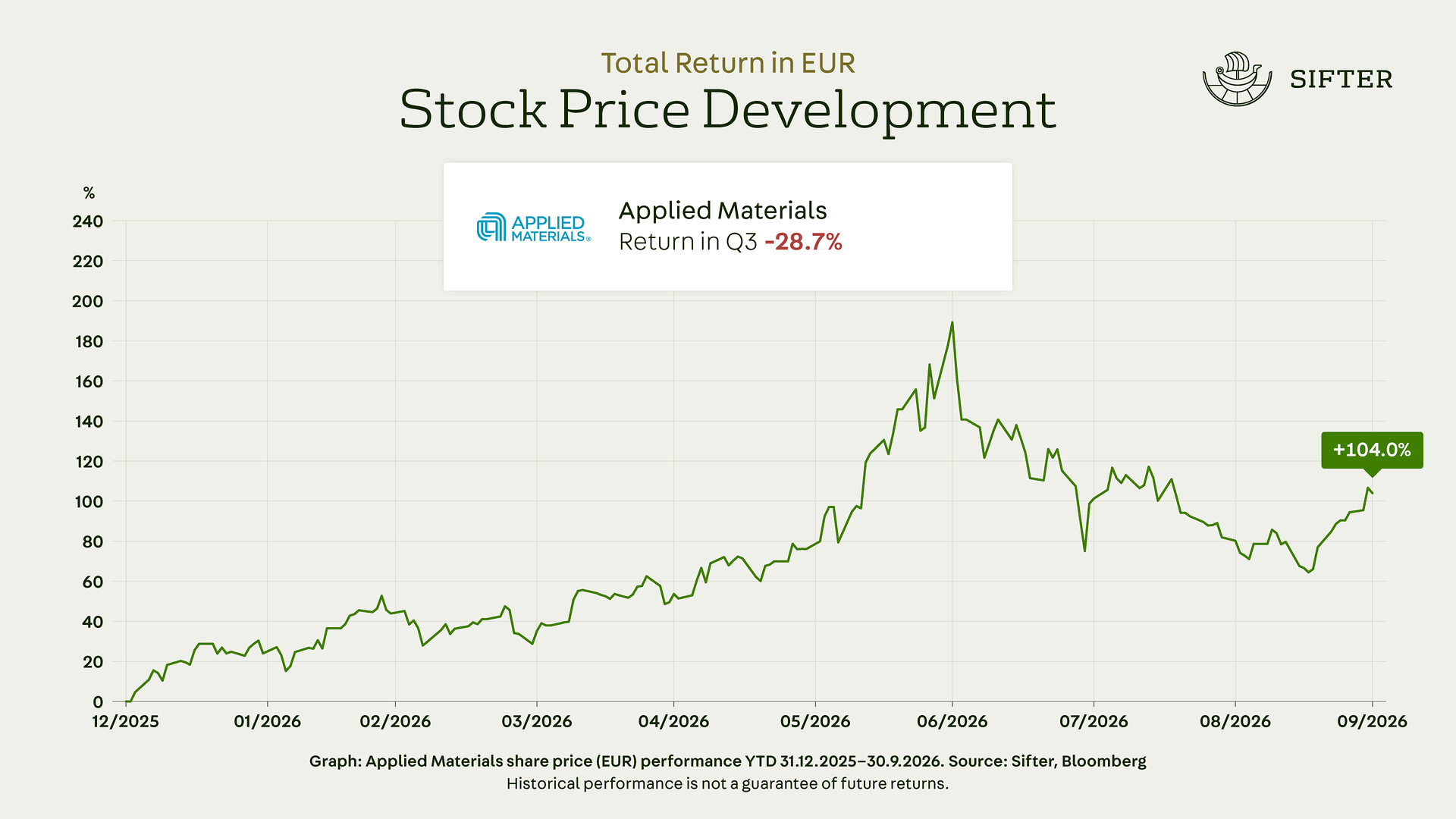
The decline of the semiconductor companies was not a major surprise, as their share prices had risen quickly to high levels during the second quarter, and the market corrected prices that had run high somewhat lower. There was no deterioration in the companies’ business operations.
Based on our own research, the semiconductor players remain very high-quality businesses, and we continue to own all of these companies, albeit at a clearly lower weight.
The decline in the semiconductor companies’ prices should be put in the context of their strong rise earlier in the year. Since the start of the year, each of these remains a firmly profitable investment.
The Portfolio’s Top 10 Holdings
The weights of the portfolio’s ten largest companies are not even; instead, they reflect our view of each company’s business predictability, risks and return potential. Microsoft’s nearly 9% weight is a result of the strong share-price rise during the quarter, and we do not necessarily expect to keep it this high over the long term.
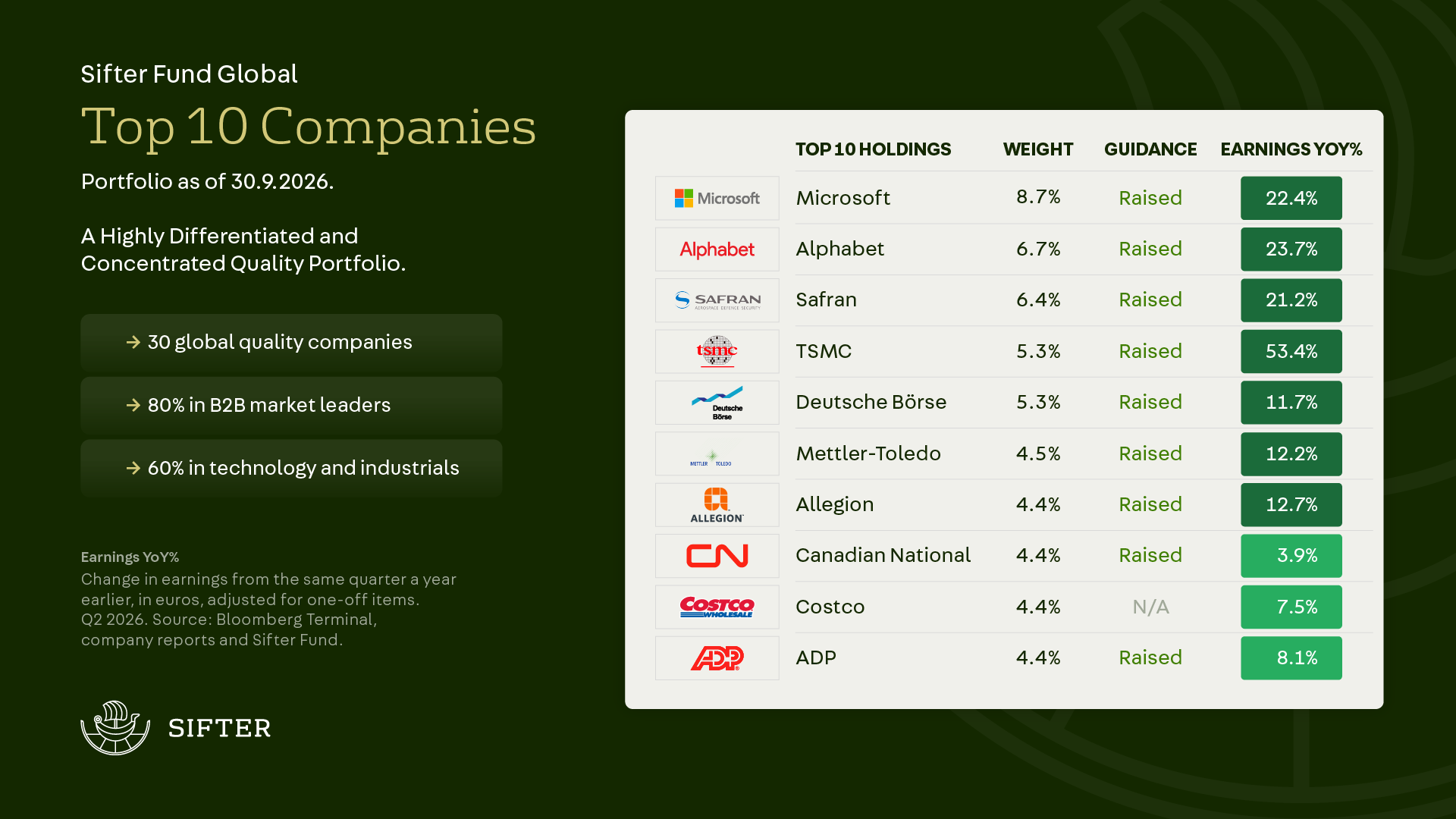
Nine out of the ten largest holdings are B2B market leaders, and we consider their business models more predictable than those of many consumer-goods and brand-driven companies.
The only consumer company (B2C) among the ten largest holdings is the membership-based retailer Costco, a business that is stable and predictably growing regardless of the economic cycle.
The portfolio’s ten largest companies are spread across six different sectors. The largest weighting is in industrial companies, but the group also includes information technology, financial services, health care and consumer staples. It is worth noting that among the ten largest companies there is only one clearly semiconductor-sector company, TSMC.
Our companies’ short-term earnings growth is currently brisk, but we focus above all on studying the longer-term, five-year earnings growth potential.
Portfolio Changes Q3
We were relatively active during the quarter. We sold the last of our Novo Nordisk shares and continued to trim Applied Materials, Lam Research and even Safran. The reduction of semiconductor companies continued in early July, ahead of the semiconductor sector’s largest share-price decline.
Overall, the portfolio changes reflect our view of where we see the most attractive long-term return potential.
In addition, we want to avoid the uncertainties that still relate to the disruptive threat of AI and the continuity of data-centre investments.
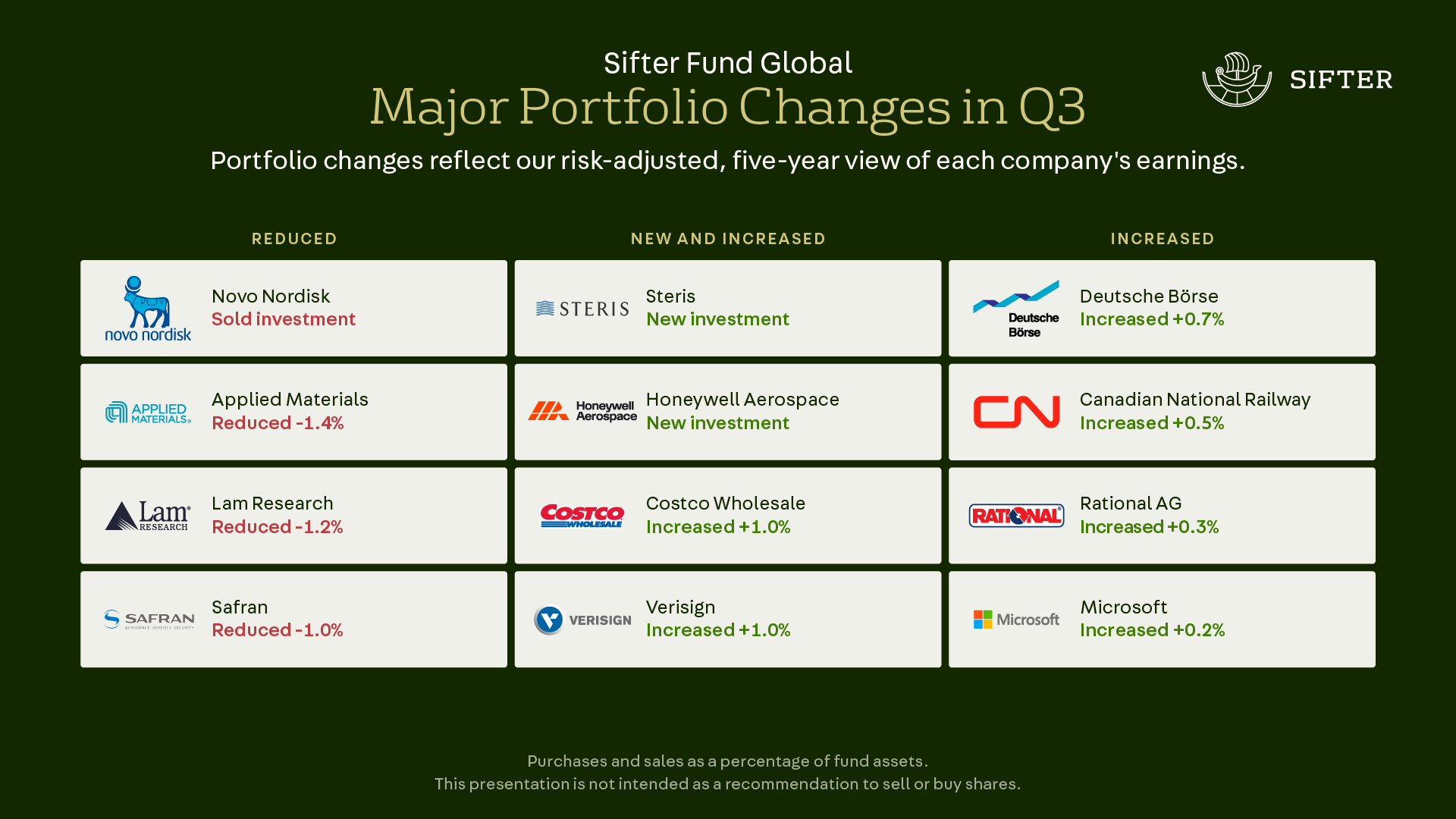
During the third quarter, two new companies entered the portfolio: Steris and Honeywell Aerospace. We will tell more about the new companies in our later reports.
In addition to these, we increased our weight in several companies: Costco, Verisign, Deutsche Börse, Canadian National Railway, Rational and Microsoft.
The common theme for the portfolio changes is defensiveness.
We now hold the portfolio in a slightly more defensive position. Although the valuation levels of the semiconductor companies have already come down, we have not yet seen a need to add to their weight in the portfolio.
Positive Drivers
We do not try to predict the market or its movements, but rather to assess possible scenarios and their effects on the companies in the Sifter portfolio. Over the coming year, we see three possible positive drivers.
A pick-up in industrial activity
Industrial activity has picked up, especially in the United States, after several years of contraction. This scenario could support the earnings growth of our industrial companies. Industrial companies make up more than a third of the Sifter portfolio.
Continued strong earnings growth of the ten largest companies
The earnings growth of the ten largest is currently strong, and the earnings-growth momentum may well continue as economic growth accelerates. Sifter’s investment strategy looks five years ahead, and in our assessments we look across economic cycles. The top 10 companies cover 55% of our portfolio.
A recovery in the valuation premium of quality companies
The historical valuation premium of quality companies is exceptionally low relative to lower-quality companies. If the market begins to value quality companies more fairly, a turn in favour of quality would not be a surprise. Should that rotation occur, we believe Sifter Fund is well positioned to benefit.
Risks
On the risk front, two things stand out: geopolitics and monetary policy.
A rapid rise in inflation and higher interest rates would weigh in particular on valuation multiples, which for quality companies are still higher than the market average. On the other hand, the balance sheets of quality companies are strong and their leverage low, so higher interest rates do not cause them elevated financing costs. High interest rates may also dampen investment, which could slow the growth of capital-intensive companies.
In geopolitics, above all the effects of the Middle East, that is, the war in Iran, are difficult to anticipate. So far, the rise in the price of oil has not caused a decline in the margins of Sifter’s companies. In addition, the Sifter Fund’s portfolio consists of companies from many different sectors, and this reduces the risk of being hit by a problem affecting only one sector or country. In short, global diversification provides protection.
Summary
Over the short term, share-price movements are market psychology, not business. Our task is not to predict share-price movements, but to own the right companies at the right price and let time do the rest. The past year has once again been a genuine roller coaster of share prices, but it is worth remembering that it has offered good buying opportunities in excellent quality compounders and delivered strong returns for Sifter investors.
We continue with our chosen strategy: we own high-quality companies globally, we maintain valuation discipline, and we are active when we believe it adds value for our investors.
Thank you for your trust.
Santeri Korpinen
CEO

