
Strong results from our holdings and broad diversification lifted the Sifter Fund in October, even as semiconductor equipment makers and Alphabet fell. The fund rose +3.4%, bringing the year-to-date return to +25.3% (PB class, 31 October 2026).
In October, most of our holdings reported their third-quarter results, and they were strong. The decliners came from the AI value chain, including semiconductor companies and Alphabet, as the market tried to judge how long the pace of AI investment can last, and what return it will generate and when.
Past performance is not a guarantee of future returns.
Why Has Sifter Outperformed This Year?
This year the market’s direction has changed quickly, and individual themes have moved share prices sharply. In a market like this, global diversification matters.
Our holdings come from different countries and sectors, and weakness in one market or theme does not decide the fund’s return.
Year to date, Sifter Fund has outperformed the global equity index by 8.9 percentage points (PB class vs. MSCI ACWI, ISAC LN, 30 October 2026). Over 70% of our outperformance has come from stock selection, the rest mainly from sector allocation. The portfolio is concentrated in a small number of carefully selected quality businesses, which we monitor and rebalance actively.
Top and Bottom Performers
Largest Holdings Keep Growing
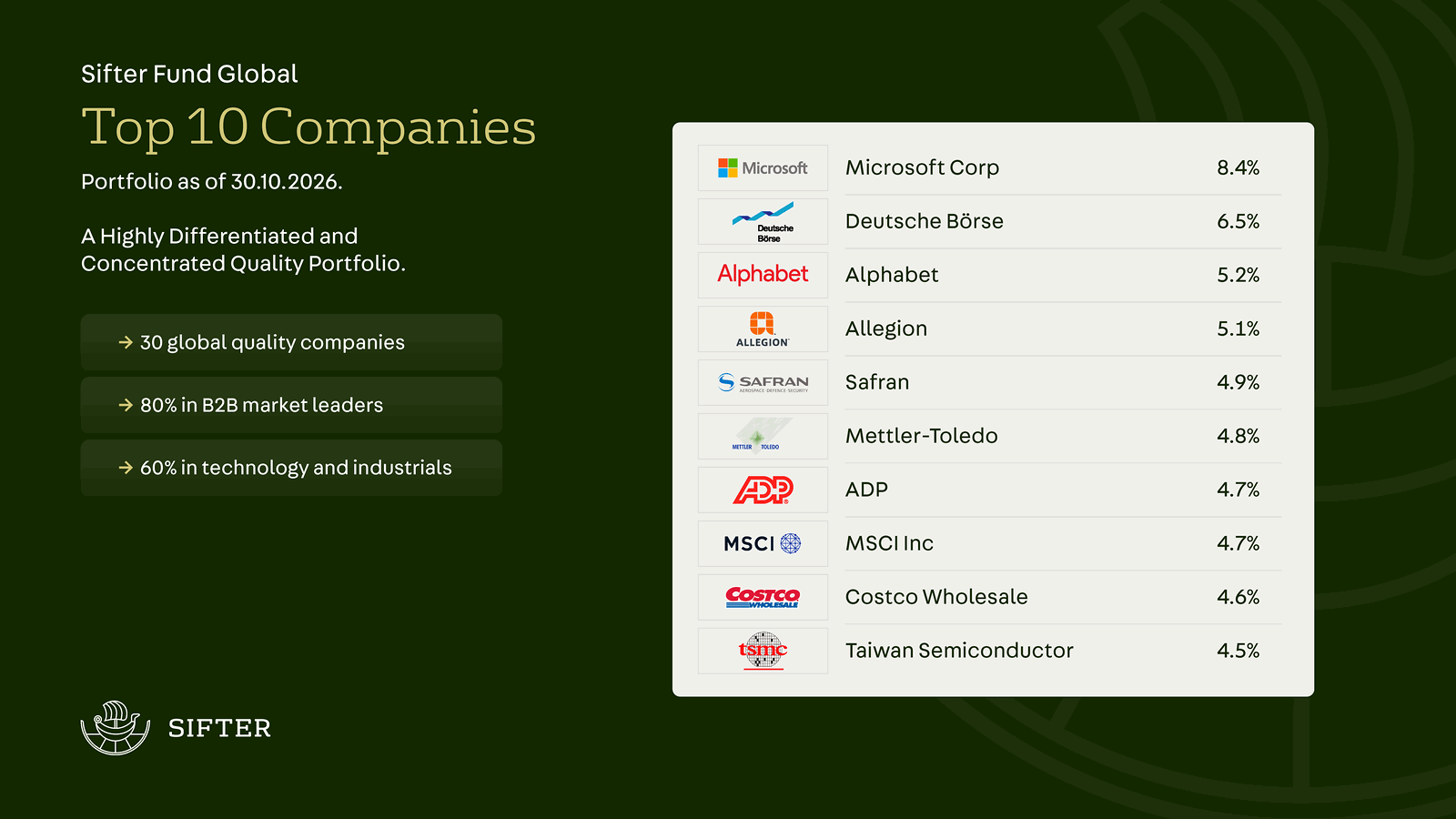
The Fund’s ten largest holdings make up 53% of the portfolio, so their development matters a great deal. Eight of them have already reported their third-quarter figures (Safran its revenue only). Revenue grew at all of them, and earnings grew at all but Alphabet, where an investment loss weighed on profit.
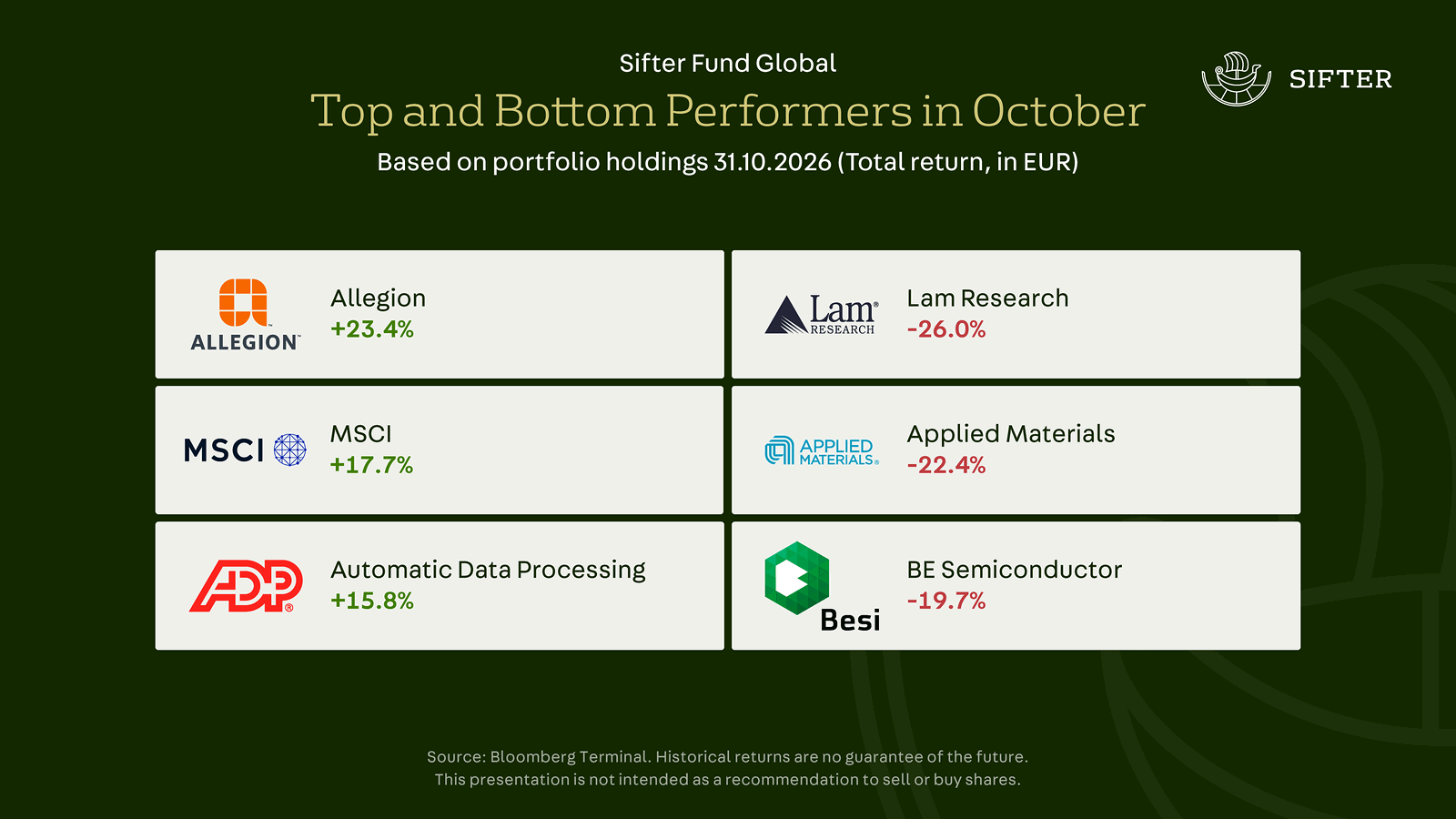
October’s best performer was Allegion (+23.4%). The company makes locks, door closers and access control systems for schools, hospitals and offices. We invested in April 2026. Third-quarter revenue grew 9.6% year on year and adjusted earnings per share 13%, ahead of analyst expectations. Growth was led by the Americas, and the company raised its full-year revenue and earnings guidance.
MSCI (+17.7%) benefited from active equity markets: index revenue grew 18% year on year, and assets in ETFs linked to its indices rose to a record $2.9 trillion.
Safran’s share price fell 18% in October as growth in its aircraft engine services and spare parts business slowed from its peak pace earlier in the year. This business generates most of Safran’s profit. The market is concerned that high fuel prices will lead airlines to cut flights, so engines are serviced less often. Aftermarket growth nonetheless remains strong, and the company kept its full-year guidance unchanged.
Semiconductors: Earnings and Share Prices Diverged
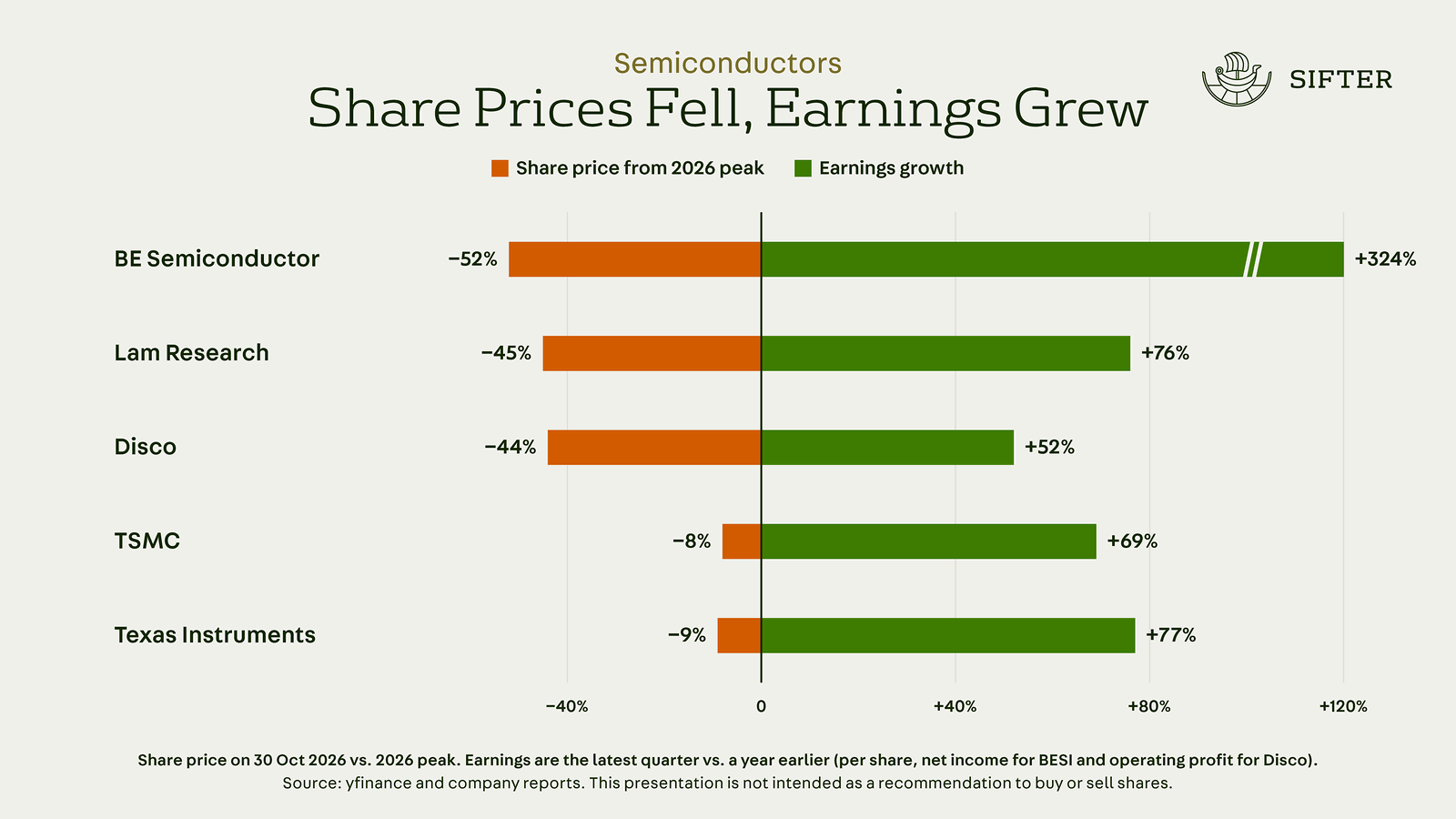
Semiconductor companies reported record results in October. In July–September, TSMC’s earnings grew 69% year on year, Lam Research’s 76% and BE Semiconductor’s 324%. Even so, semiconductor equipment shares have fallen by roughly half from their June peak.
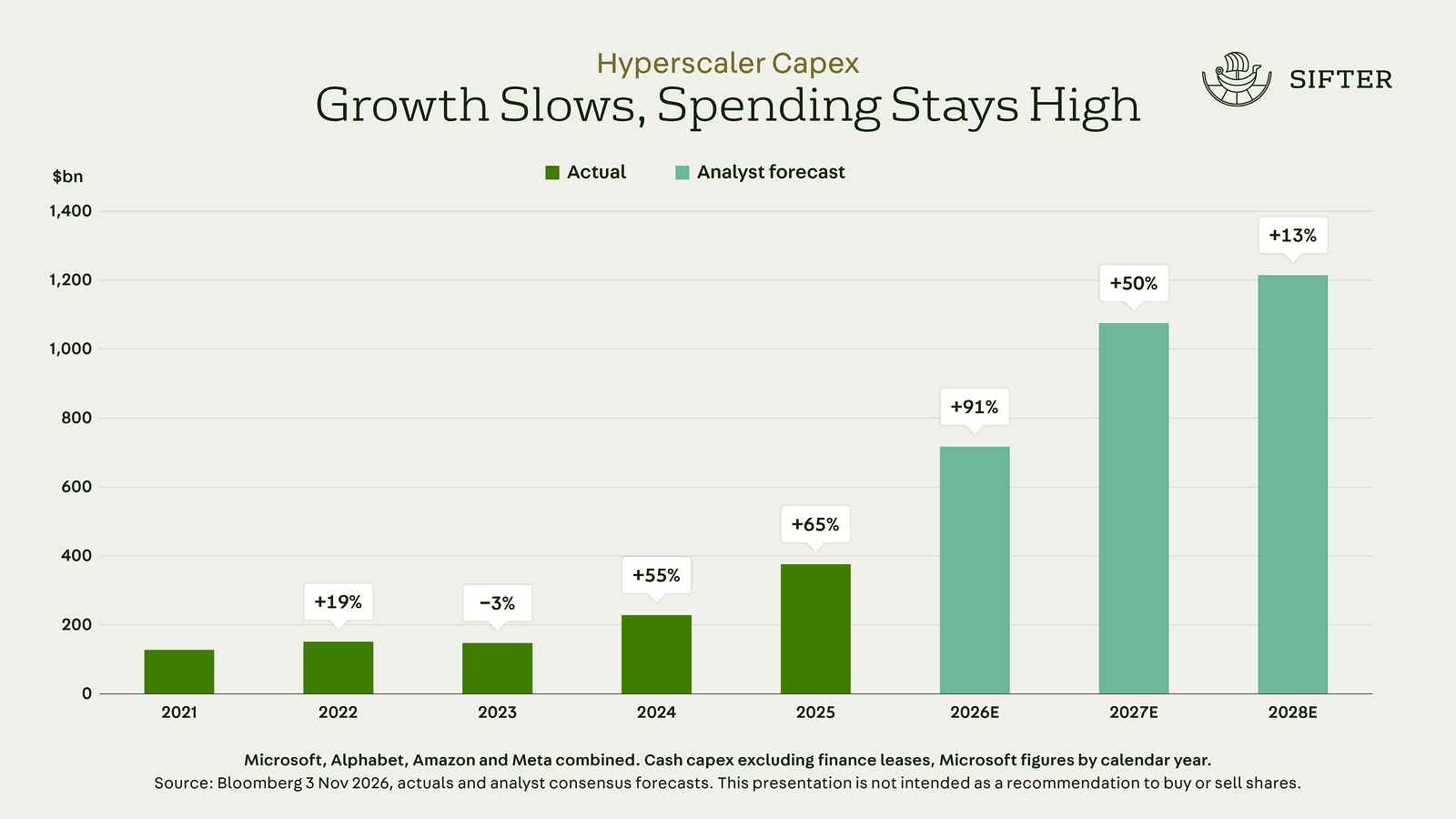
Why is the market cautious? Growth for semiconductor equipment makers is ultimately driven by cloud companies’ data center investment. When hyperscalers such as Microsoft, Alphabet and Amazon buy more AI chips, chipmakers like TSMC need new fabs and the equipment to fill them. The hyperscalers have funded their investment so far mainly from their own cash flow, and that capacity is now largely used up. When free cash flow turns negative, the money has to be raised through debt or equity, and that has raised doubts in the market. Once investors start to question whether the investment will continue, cuts are likely to hit equipment makers first, which is why their share prices have fallen.
According to Bloomberg consensus, analysts expect hyperscaler capex growth to slow from around 91% this year to 50% next year and 13% in 2028.
Why are we not adding to equipment makers after the fall? Simply because we look further ahead. Equipment makers have visibility for a couple of years, and next year’s outlook is strong, but in Sifter’s investment strategy we assess companies five years out.
Equipment makers sell tools to new chip fabs. New fabs are built when chip demand grows. If that growth slows, fewer fabs are needed even if chip demand stays high. A record year can therefore be the peak of the cycle. Because equipment makers’ earnings are hard to forecast far ahead, our forecasts are cautious, and on those forecasts the shares are still fairly expensive relative to the Sifter portfolio.
In a cyclical company, an investor faces two risks: earnings can fall short of forecasts, or the market may no longer pay the same multiple for them.
At worst both happen at once, and then even a good company can be a poor investment. That is why we have not yet increased these positions, even though their share prices have fallen considerably. We are ready to change our view if we gain more visibility into their long-term earnings growth, or if valuations fall to a level we find attractive.
Are Data Center Investments Profitable?
We own two cloud companies, Microsoft and Alphabet. Both are growing their AI businesses rapidly, and demand still exceeds capacity.
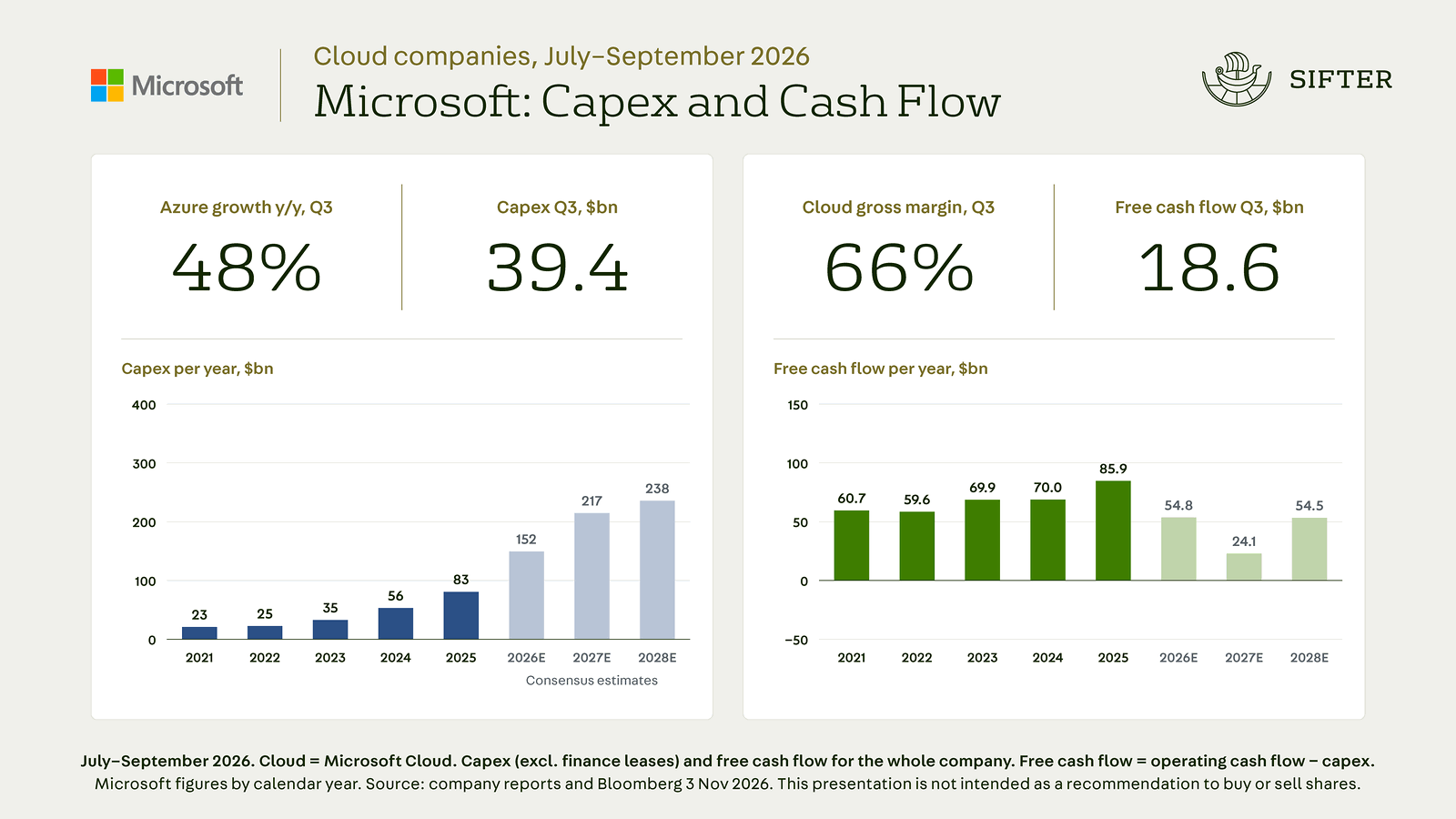
Microsoft is getting more out of its existing capacity. Bottlenecks have been eased and the profitability of existing capacity has improved: the cloud gross margin rose from the previous quarter to 66%. The company funds its investment from its own cash flow and through leases, and according to its guidance free cash flow will remain positive, at least for now, unlike at many other cloud companies. Microsoft also returned around $10 billion to shareholders through dividends and share buybacks.
Alphabet owns the entire AI value chain: its own AI chips, its own cloud infrastructure and its own language models. Google Cloud’s profitability has improved quickly, with its operating margin rising from 24% to 36% in a year. At the same time, however, capex doubled and exceeded free cash flow from operations, and the company raised $41.4 billion through a share issue and debt.
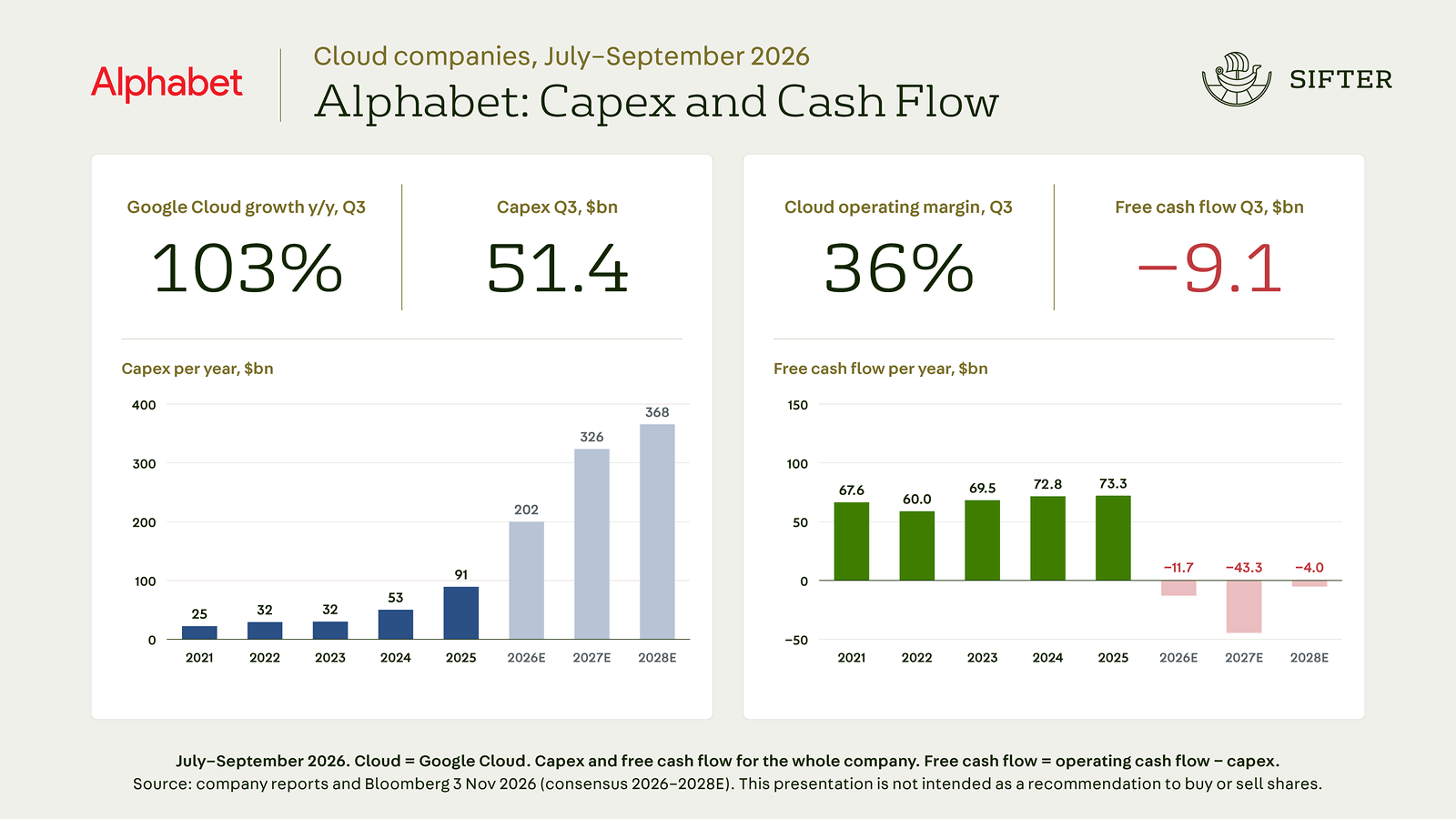
Alphabet’s biggest question is the slowdown in Search. AI appears to be eating into Google Search, which still accounts for just over half of the company’s revenue. If Search growth keeps slowing, the cash flow that funds the investment will be smaller than expected. Alphabet’s share price fell 17% in October, which was also visible in the fund’s return, but strong performance across our other holdings made up for it.
What could change the picture? If operating cash flow strengthens materially, for example through Google Cloud’s growth, and is enough to fund even larger investments, concerns about funding will ease. We track this every quarter.
The AI winners will not be decided by how much they invest, but by how quickly that investment turns into cash flow.
Industrials Are Growing
In August we wrote that industrial activity was starting to pick up. October’s results confirmed the picture. The global manufacturing purchasing managers’ index (PMI) is at its highest in more than four years, and new orders are growing at their fastest pace over the same period.
We see the same in our holdings. Texas Instruments’ chips are used in factory automation, power grids and machine control, and its industrial sales reached a new high for the first time in four years. Atlas Copco’s compressors and vacuum pumps go into factories and semiconductor production, and its vacuum technique orders nearly doubled.
Growth is uneven, though. North America and Asia are leading, while Europe lags. The gap was clear in Atlas Copco’s orders, and Allegion’s international sales were flat due to weakness in Western Europe.
We like industrial B2B companies because their business is predictable, and AI makes them more efficient rather than threatening them.
Summary
October was a good month, and the portfolio’s gains were broad. Still, a single month says little about what ultimately matters in investing.
Over the long term, a share’s value tends to follow the company’s earnings growth. In the short term, prices move with sentiment, sometimes running ahead of earnings and sometimes falling behind. In October we saw both.
Our task is to stay calm in both directions.
We follow our companies’ businesses, keep our valuation discipline and let time do its work.
Thank you for your trust.
Santeri Korpinen
CEO, Sifter Capital

