

For many investors, the stock markets are like a carousel. Sometimes they wait for it to slow down so they can jump on. When it eventually slows down, they are worried it will come to a complete halt. Ultimately, they end up just standing by and watching. This natural psychological phenomenon tends to keep us from taking action. What we need is a different mindset.
This article is based on my personal notes from 2018 to 2025. The first version was published in October 2020 and last updated on May 20, 2025.
Over the past eight years (2018–2025), the stock markets have been a wild rollercoaster ride. Still, the long climb has pointed upward. From time to time, momentum has been regained from lower levels — sometimes for months, sometimes even for a year.
The article contains several stock price charts. Please remember that past performance is not a guarantee of future results.
Timing the stock market is impossible
The past eight years have brought unusual moments for many investors. For me personally, one thing has become increasingly clear: timing the market is impossible — at least systematically and over the long term.
That’s why Sifter Fund’s investment strategy is to remain an owner of high-quality companies at all times — regardless of market fluctuations.
2018 – “Share prices can’t go any higher”
In 2018, many investors and media headlines strongly believed that the stock market carousel had reached its highest speed and prices could not go any higher. They sought to justify this view by suggesting that the stock markets had been rising for too long, the global economy was slowing down and there were tensions between the United States, North Korea and China.

Therefore, many investors expected a market correction that would create the opportunity to invest more. Indeed, there was a long-awaited slight dip in the market near the end of the year. The Sifter Fund also declined by 12% at the end of 2018. Many investors decided to wait and see whether the stock market decline would continue once it had begun. It didn’t.
2019 – Growth continues after all
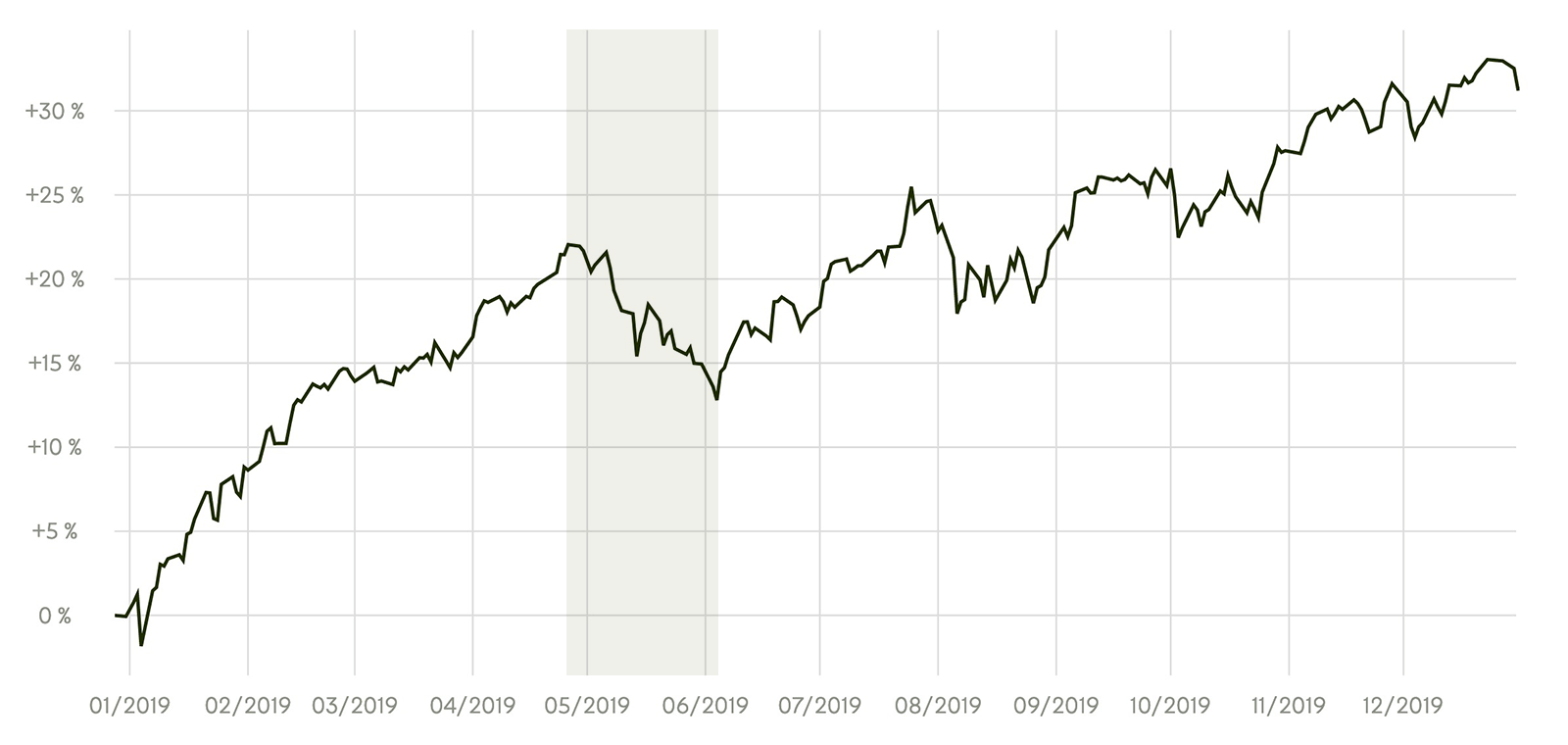
Year 2019 began surprisingly with strong growth. The value of the Sifter Fund grew by 24% during the spring (January 1–April 30, 2019). Those who had decided to wait on the sidelines were disappointed. They now thought the upward move had been too sharp. Consequently, their only logical move was to wait for the next downward correction.
The spring and summer of 2019 did bring a brief, month-long dip of 7% (May 1–June 4). However, this was not enough of a decline for those who were waiting for a larger correction – after all, prices had already been lower in 2018.
Waiting wasn’t rewarded this time either. The stock markets continued to rise toward the end of the year, and quality investing delivered a +31.3% annual return for the Sifter Fund in 2019.
“Share prices must come down after rising so sharply,” the papers said.
2020 – The COVID-19 pandemic takes the world by surprise
The year 2020 started with the same trend of moderate growth. The Fed had already started to raise interest rates, which slowed down the rise of prices in the US stock market to some extent. Some of the investors who had waited for a downward correction for a long time decided to finally invest at least part of their available funds. There didn’t seem to be many alternatives and the global economy kept moving forward, albeit at a slower pace.
In late January, news began to come out of China about a threatening virus, but the Western world initially believed that the new virus was only a problem for China to contend with.
On the weekend of February 15–16, Italy awoke to COVID-19. Investors responded to the news of the spread of the outbreak and the uncertainty it caused by panic selling. Sifter’s value fell by 31% (February 17–March 24). By comparison, the S&P 500 declined by 34% and the Eurostock 50 index by 38%.
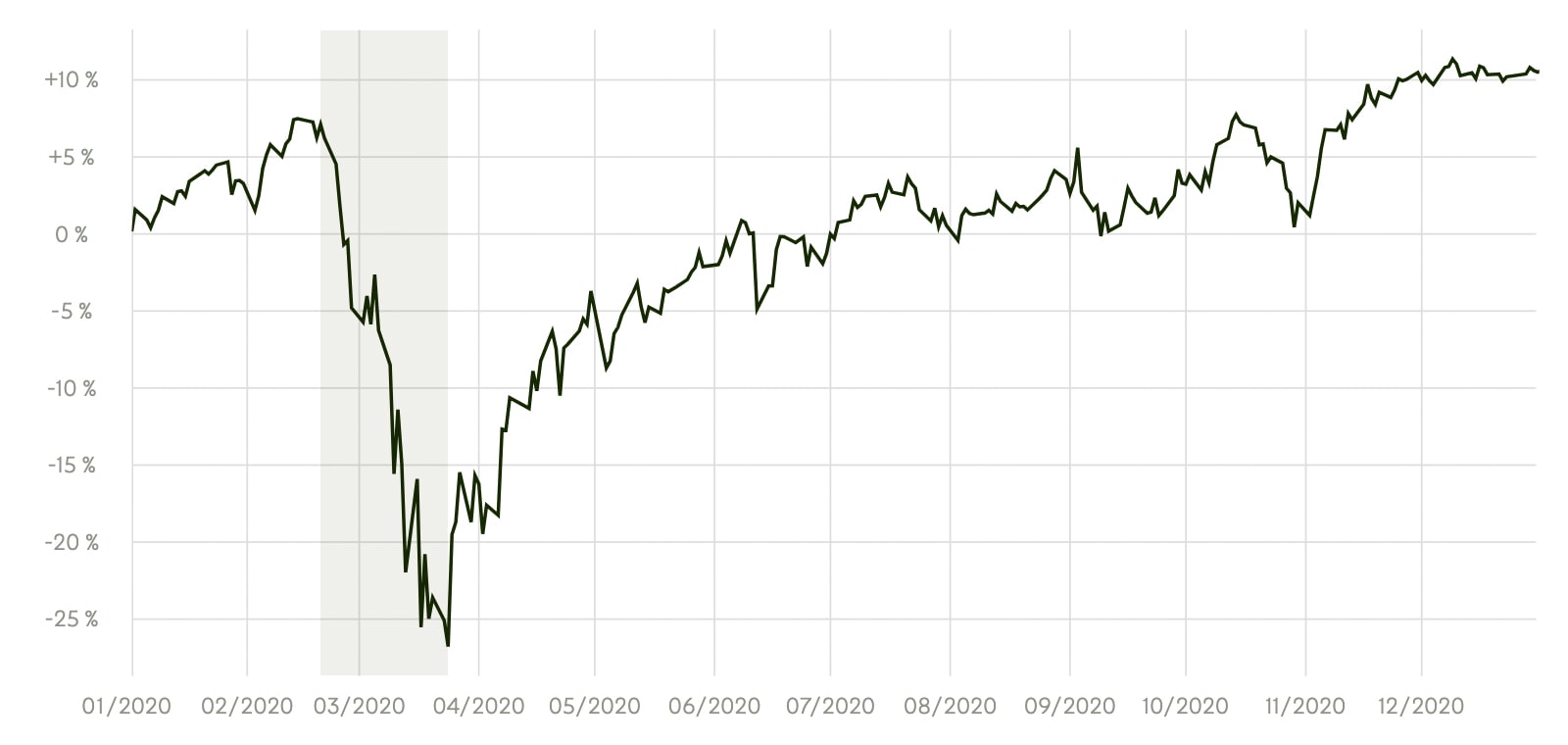
The stock markets had finally returned to the levels seen in September 2017. More than two years of growth evaporated in a month.
Unfortunately, the sharp market drop also brought a significant increase in uncertainty about the future. There was talk of the worst recession ever, a wave of bankruptcies, and of course, the virus itself. The market’s fear gauge, the VIX index, was near its all-time high.
For investors who want to time the market, this would have been the right moment to take action.
The carousel nearly came to a standstill, but only for a moment. The price rally that followed in the subsequent months took almost everyone by surprise. Sifter’s value increased by 35% (March 27–May 30) practically over a period of two months, returning to the level seen at the beginning of the year.
Still, many people thought the fall and rise had been too sharp. It would be better to wait for the markets to decline again.
However, things turned out differently. Central banks and governments continued their stimulus measures. Not even the US presidential elections or the unleashed wave of the coronavirus managed to spook the stock markets anymore.
Despite a tumultuous year and strong volatility, 2020 yielded a +10.5% annual return for Sifter Fund investors.
2021 – A Surprise guest arrived at the party: Mr. Inflation
January 2021 started on a very strong note. It was only a matter of time before the COVID-19 vaccine would be ready and the spending spree could begin.
There was pent-up demand everywhere, except for staying at home.
In April, we received the long-awaited company Q1 results, which were surprisingly excellent. The markets had anticipated future cash flow celebrations, and alongside them, the Sifter Fund also rose by 13.9% (from January to May 2021).
As summer approached, COVID-19 seemed almost familiarly safe, and the economy was steaming ahead. Unfortunately, the party was joined by a long-missing guest named Mr. Inflation.
Markets were once again puzzled by the new uncertainty, and a familiar mantra echoed in investors’ minds – it’s never the right time to invest.
In the spring of 2021, it would have been an excellent time to get into stocks, as the market’s bullishness continued to the end of the year, regardless of inflation concerns.
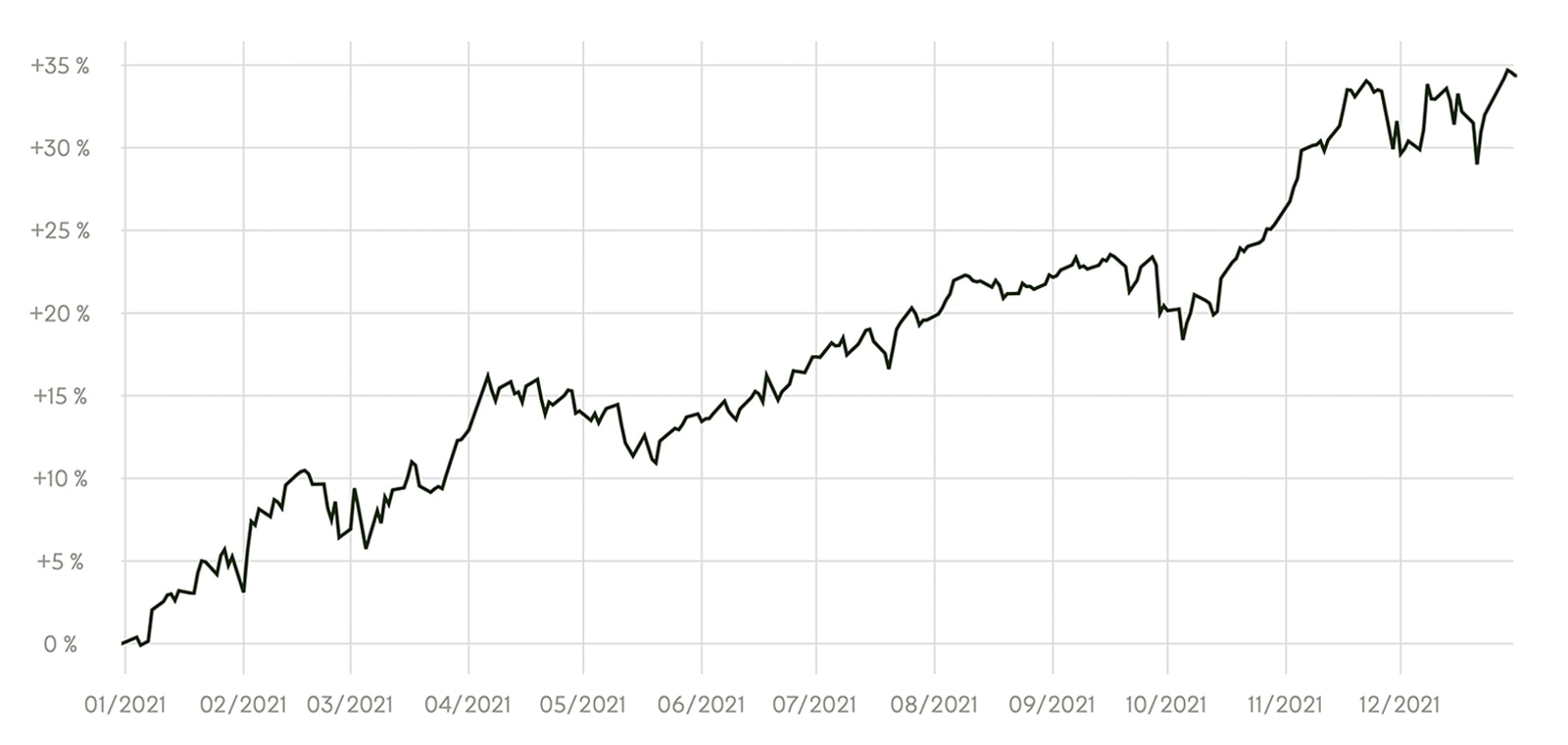
The year 2021 was recorded in the history of the Sifter Fund as its strongest upward year, with growth exceeding 34%.
2022 – The stock market decline finally came, and War
In January 2022, central banks were poised for severe actions. The US Federal Reserve had resolved to subdue the surging inflation, and there was talk of a Volcker-style approach.
Paul Volcker was a legendary central bank leader (1979-1987) who wrestled the prolonged inflationary spiral but also stifled the entire US economy into a recession with excessive interest rate hikes.
The FED took drastic measures and raised interest rates from zero to five percent in a year (4/2022-6/2023). This alarmed investors, especially growth company stocks plummeted since money had a cost again.
In March 2022, events unfolded that many believed were no longer possible. War in Europe.
This was the final straw for many investors, particularly European companies with extensive business activities suffered greatly.
Russia’s invasion of Ukraine, high inflation, and steep interest rate hikes spooked investors severely, resulting in a 14.5 percent decline for the Sifter Fund in 2022.
A small defensive victory in a challenging market. We remained 100% invested in stocks. Global diversification helped.
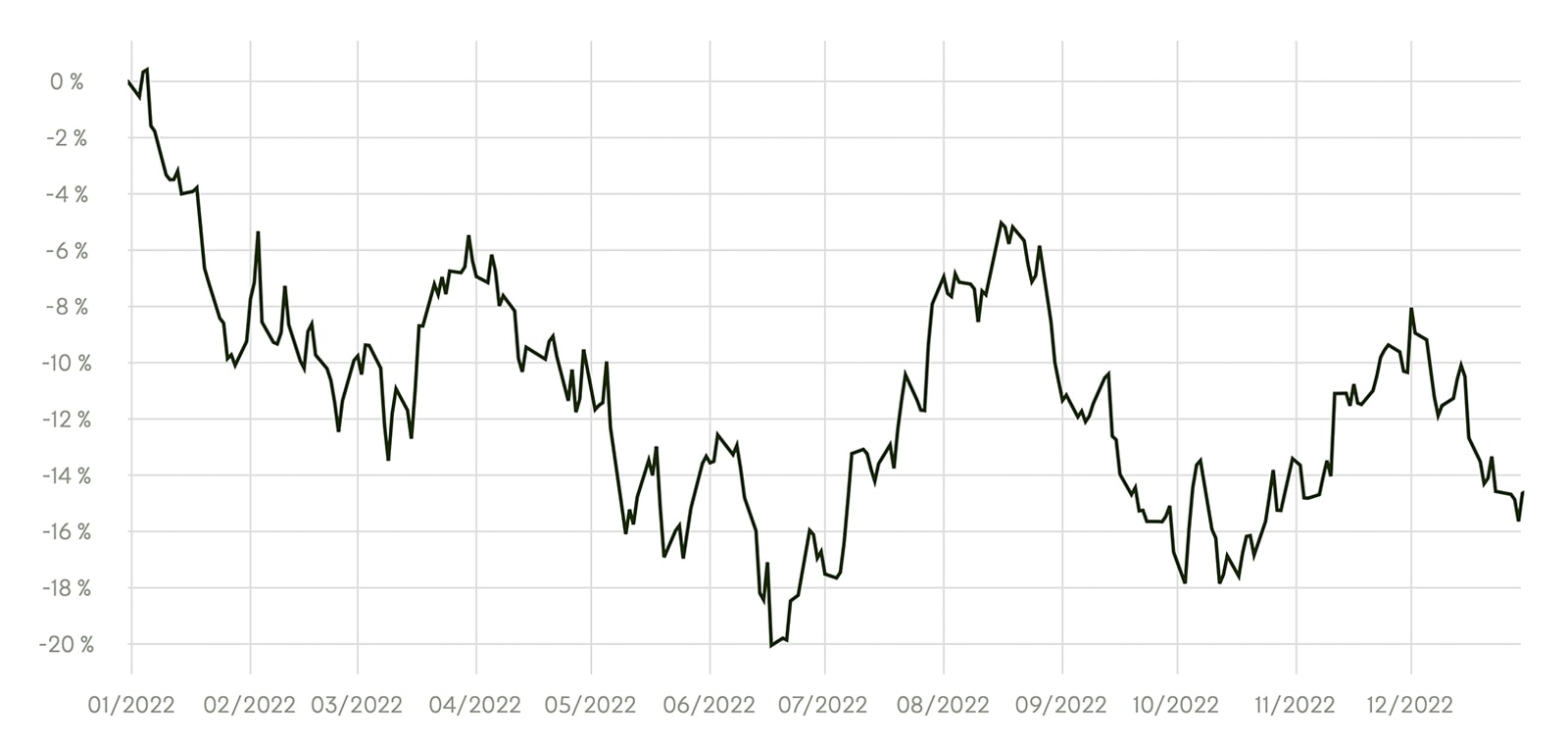
Tech, growth, and semiconductor companies plummeted. We saw a long-term quality investor’s buying opportunity and added quality semiconductor companies to the portfolio at up to a 50% discount on their previous years stock price.
Many seasoned investors over the years were vigilant in the fall and began stock purchases, even though the uncertainties of the macro world were still fresh in memory.
2023 – The wheat separates from the chaff
Stock markets have a unique ability to absorb new information and risks, chew on them for a moment, and then forget them. This happened in early 2023.
The war in Ukraine continued, inflation was still high, interest rate hikes persisted, and even a recession was being discussed.
Concerns began to emerge in the real economy as well. There were profit warnings, but at the same time, some companies continued their growth. The wheat separated from the chaff.
During the era of free money, companies that had accumulated debt began to grapple with financial issues.
The banking sector took a severe beating in March when several American banks collapsed, and in Europe, Credit Suisse crumbled under the weight of its loans.
The troubles in the banking sector did not weigh on Sifter, as we don’t invest in banks. The reason why became evident during the spring.
The stock market looked far ahead and saw the sunshine behind the clouds. If inflation drops, central banks will have to lower interest rates. This began to manifest in the rise of growth company stocks.
The stock selections made by Sifter in the previous year started to bear fruit. Expectations of falling interest rates increased, which quickly lifted the share prices of tech and semiconductor companies.
The losses from the previous year were now fully recovered.
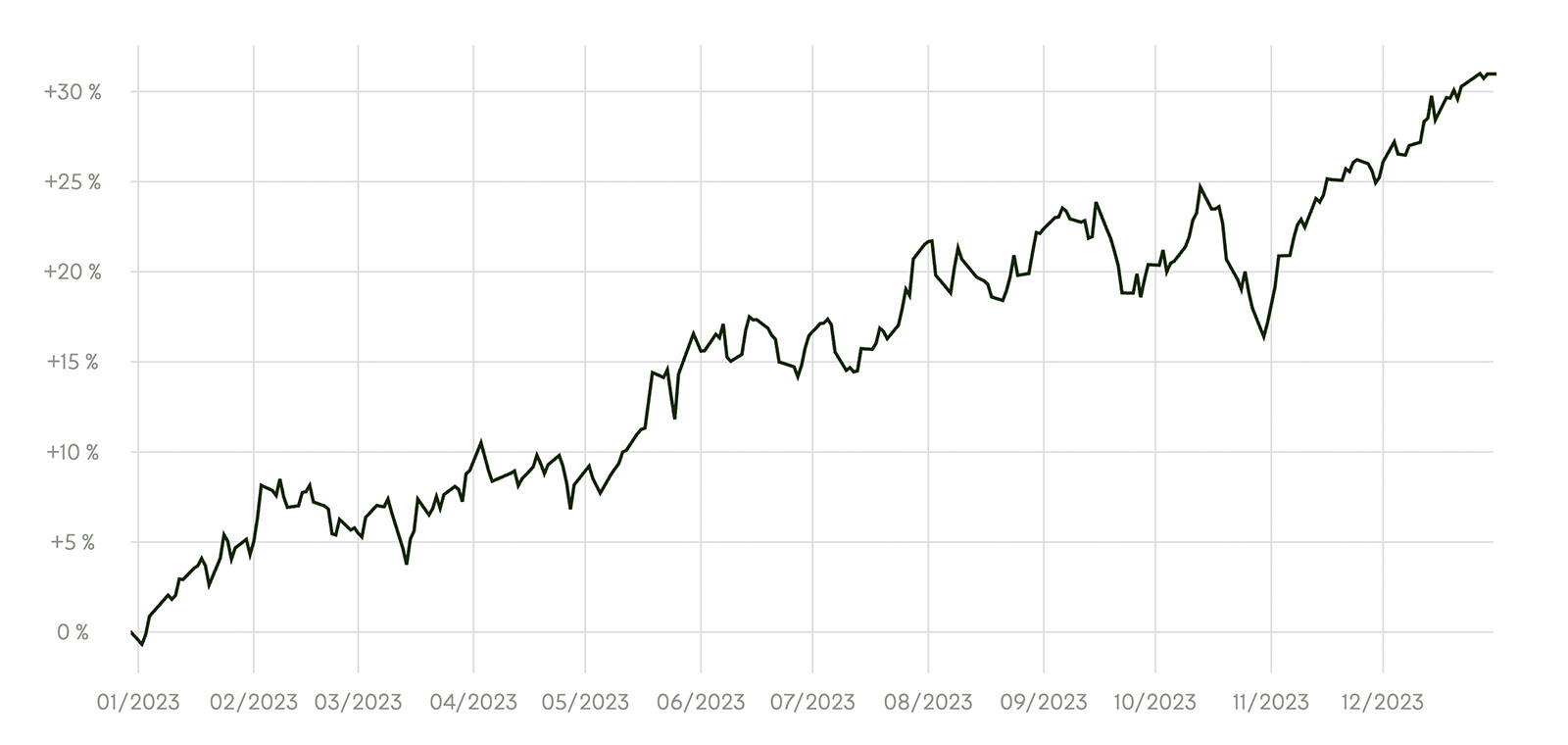
The semiconductor companies acquired at attractive valuations, along with Novo Nordisk, ultimately delivered a 31% annual return for the Sifter Fund. Investors were thrilled.
2024 – Expensive? Yes. But the music kept playing
The dance of 2024 continued in the same shoes the year 2023 had ended with. The economic fundamentals were in excellent shape, and stock prices kept climbing. In January 2024, during our annual video report, we warned about the high valuations of U.S. companies — but the market didn’t care, as artificial intelligence (AI) was making a strong breakthrough.
We updated the five-year earnings outlooks for the companies in the Sifter portfolio and compared them to current stock prices. The result was clear.
We began a significant reduction in holdings of technology companies we considered excessively overvalued — such as the Japanese company Disco Corporation, whose share price had risen 200%.
While quality companies can be held with peace of mind for the long term, overpriced ones should not remain in the portfolio.
Media headlines were buzzing with Nvidia’s earnings growth and the promising outlook of U.S. tech companies. The spring rally continued strongly, and investors seemed to see only one direction — upward.
In April 2024, at our investor event, we highlighted the effects of recency bias and reminded our investors that it is not normal to expect 30% annual returns going forward — or any returns at all, necessarily.
We reinforced this message again on June 17, 2024, when we published the article: “Can exceptional returns become a permanent phenomenon?”. The answer was obvious: they cannot.
Then, summer holiday ended — unexpectedly.
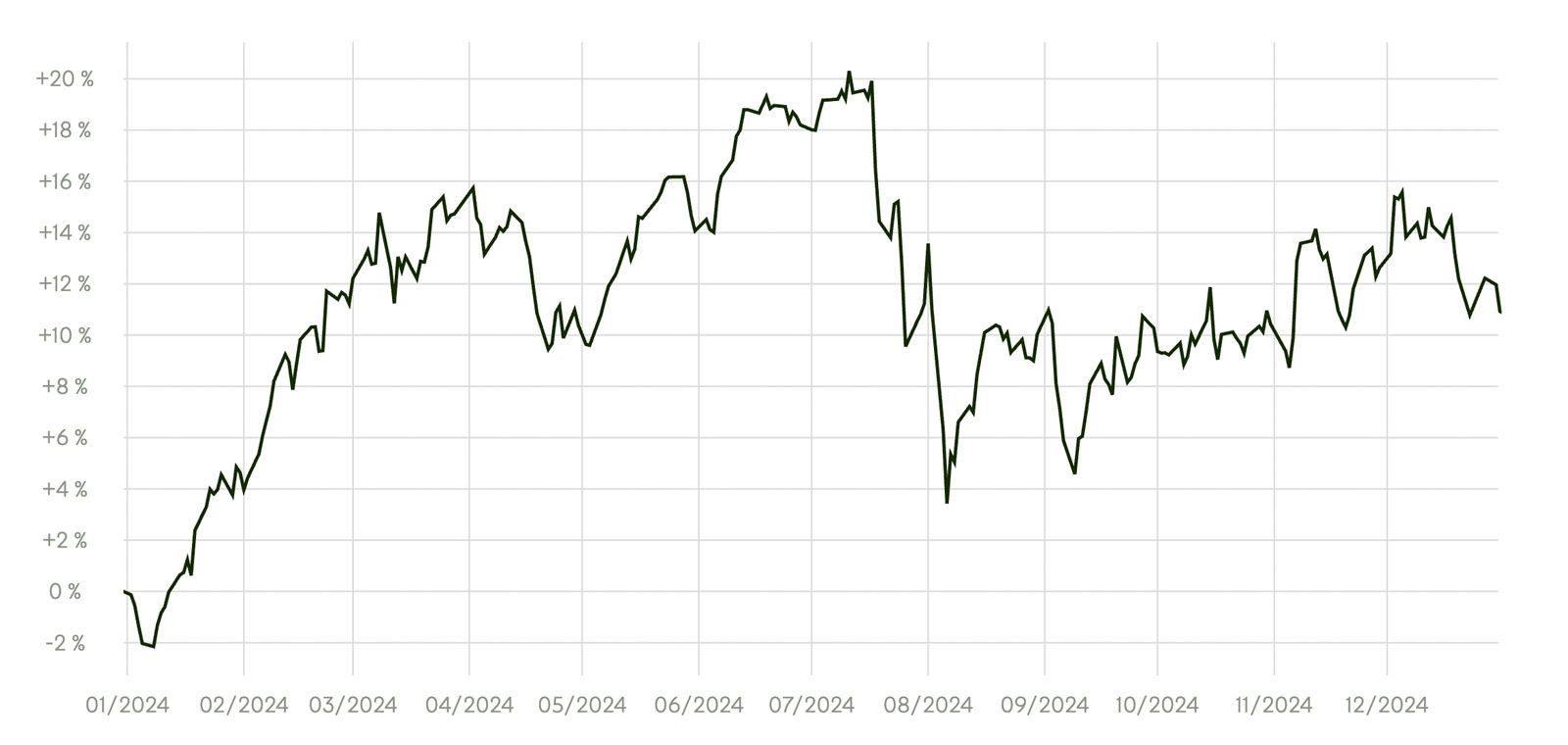
About a month later, during the hottest days of the summer holiday season, an unexpected downturn began in the stock markets — leading to a 15% decline by early August.
Investors around the world came to the conclusion that company valuations and earnings expectations were no longer realistic.
In the U.S. presidential debates, candidates enthusiastically began discussing new technology export restrictions to China, which especially weakened the outlook for semiconductor companies.
Storm clouds began to gather over investor sentiment. But greed ultimately won, and stock prices continued to climb through the rest of 2024 — partly because the United States elected the most stock-friendly president in history.
The so-called “Trump euphoria” ultimately delivered a 10.4% annual return for the Sifter Fund — a rather respectable outcome.
2025 – The most stock-friendly president in history surprises
The year 2025 began with Trump-style momentum — and the economic fundamentals were in exceptionally strong shape. Analysts expected corporate earnings to improve by more than 12%, employment was at record levels, and inflation was just a faint memory.
Respected asset managers around the world forecasted a moderate 10% rise for the S&P 500 index in 2025. It seemed like the perfect time to invest. But then came a surprise.
In February 2025, the 47th President of the United States was sworn into office — and decided to follow through on his tariff threats. The era of unfair global trade was over. The U.S. intended to set the rules of the game.
On April 2, unprecedented uncertainty returned to the markets after President Trump delivered his Liberation Day speech — and panic took over the stock markets.
No one could calculate what the extremely high tariffs would mean for the global economy and corporate earnings. Now, the economic system seemed to be at genuine risk. Stock prices plunged as uncertainty surged. Between March and April, nearly a quarter of the Sifter Fund’s value temporarily disappeared — bringing it back to 2023 levels.
When prices hit bottom, uncertainty was at its highest point in years. On April 8, the VIX fear index surged above 50 — a clear signal that the market was in panic mode.
In response, we published an article in April: “Spring discounts in the stock market — is it time to buy?”
According to Sifter’s own valuation models, our portfolio’s five-year earnings yield had increased — simply because share prices were significantly lower.
But uncertainty was intensified by one fact: economic predictability had vanished.
Once May Day festivities were over and the cold spring winds swept through the streets of Helsinki, stock prices began to recover. Around May 7, investor greed returned to the market, as President Trump announced a tariff pause — except for China.
This time, the market crash turned out to be one of the shortest in history. The decline offered bold investors an opportunity to buy while others were still afraid and selling.
Has it paid off to invest in stock market?
Despite all the uncertainty, the value of the Sifter Fund has risen significantly over the past seven years.
This period has included several corrections of more than 10%, a decline of over 30% during the COVID crash in 2020, a bear market in 2022, and most recently, the spring 2025 selloff.
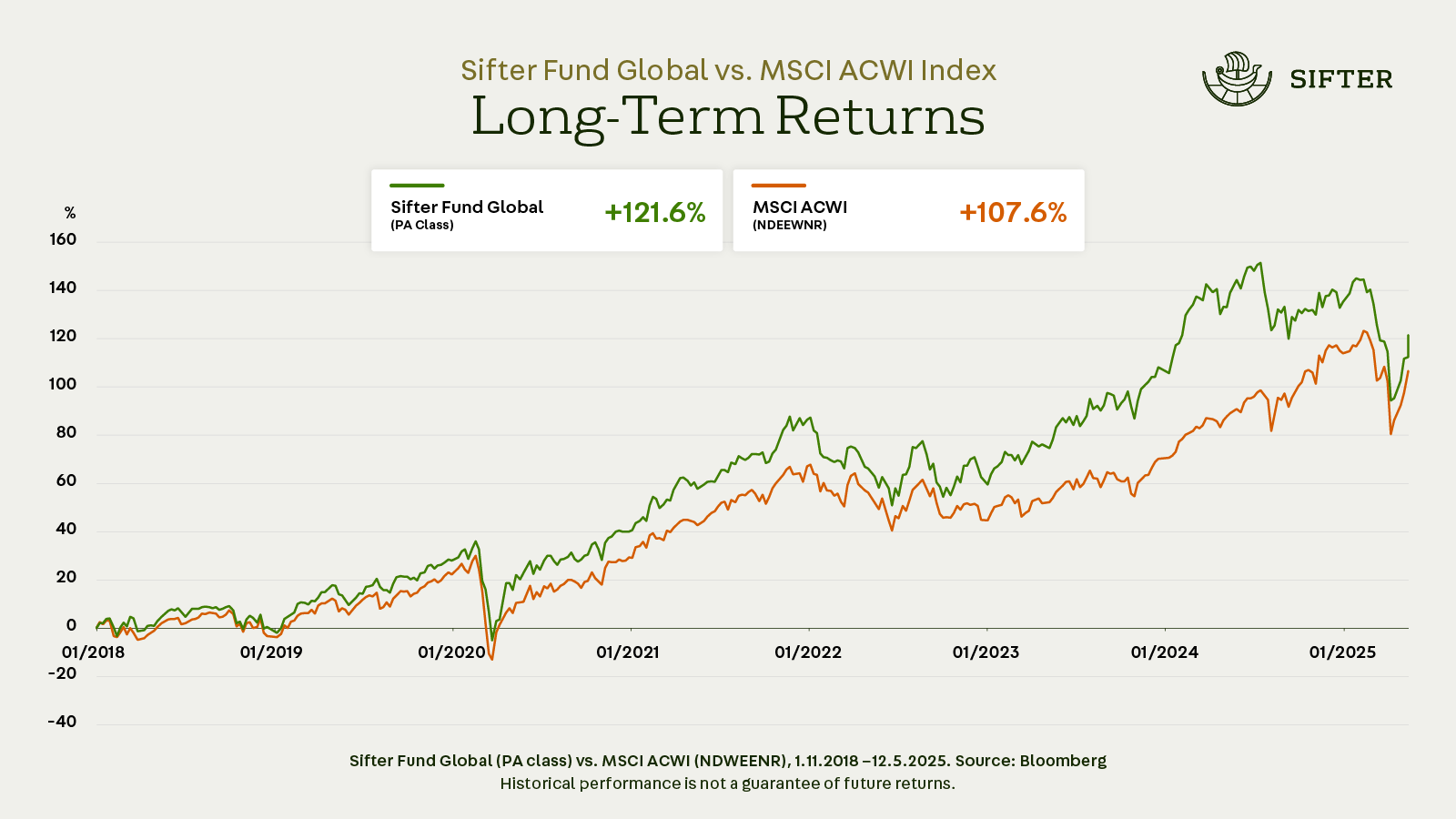
Sifter’s quality strategy has delivered stronger returns over this period than the global equity index (MSCI ACWI). Please remember that past performance is not a guarantee of future results.
For those waiting for the perfect entry point, one thing is certain: when stock prices crash, uncertainty is at its peak.
Uncertainty is the price of equity investing — and it must be endured if you want returns.
Invest in quality businesses, not in daily stock price movements
I present an alternative approach that sounds rather simple.
- Buy carefully selected high-quality companies with a strong earnings model, pricing power, and predictable business performance.
- Focus on the company’s ability to make money and sustain its competitive advantages — and don’t pay too much attention to daily stock price movements.
- Replace the company when you find a better one or when the company’s earnings model is permanently diminished.
For many people, such a calm and systematic approach to investment is a strange idea. Indeed, it’s not a question of investing, it’s a question of owning.
It’s far more rewarding to own high-quality businesses for the long term and let them work their magic — rather than constantly watching stock price fluctuations and stressing over macro events
The role of the Sifter Fund is to act as that part of an investor’s equity portfolio where you can remain as an owner even when the stock market is turbulent.
Long-term quality investing best describes Sifter’s investment style. We have also written a guide on the topic: Long-Term Quality Investing.
Santeri Korpinen
CEO, Sifter Capital

